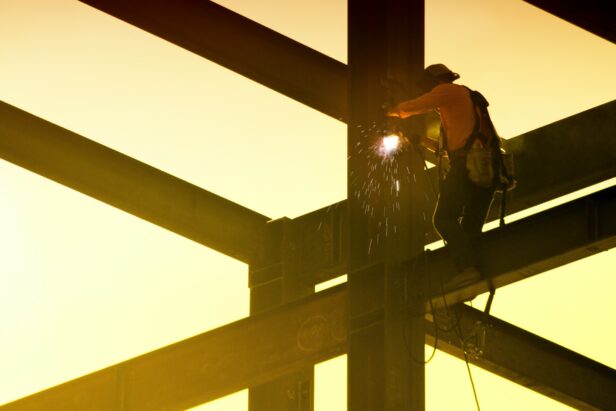
Steel-frame commercial construction uses hot-rolled and cold-formed steel members as a building’s structural skeleton. These systems integrate columns and beams with purlins, girts, and bracing to transfer vertical and lateral loads efficiently through predictable load paths to the foundation.
Steel offers a strength-to-weight ratio superior to that of traditional materials, enabling longer spans without interior supports while maintaining excellent deflection control. Steel’s non-combustible nature provides inherent fire safety, and off-site fabrication allows all-weather installation that can significantly compress project schedules relative to concrete construction. The material’s high recycled content and full recyclability align with current sustainability goals while supporting the open floor plates that today’s commercial occupancies demand.
Which Steel Frame Systems Fit Common Commercial Needs?
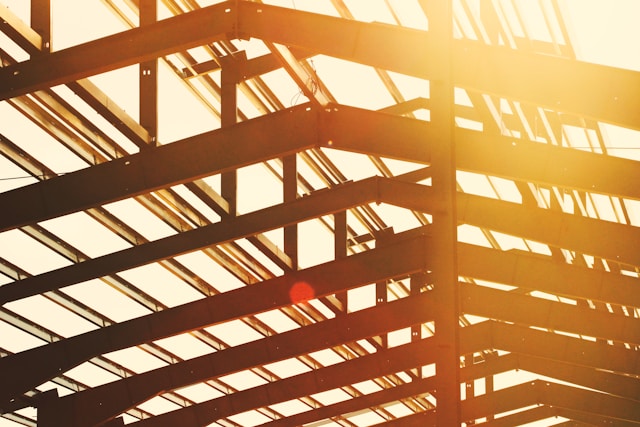
Commercial construction relies on four primary steel framing systems, each engineered for specific performance requirements and building types. Portal frames excel in industrial applications, braced frames provide economical lateral resistance, moment-resisting frames enable open floor plates, and wall-bearing systems combine steel efficiency with masonry mass.
Rigid Portal Frames for Industrial Applications
Portal frames use moment connections between columns and rafters to create rigid joints that eliminate the need for interior bracing. The system typically incorporates eave haunches – reinforced sections where columns meet rafters – to handle concentrated bending forces. This configuration enables clear spans of approximately 25 to 35 meters, making portal frames ideal for warehouses, manufacturing plants, and industrial facilities requiring unobstructed interior space.
We design portal frames using hot-rolled steel sections with welded or bolted moment connections at critical joints. The rigid connections transfer vertical loads and bending forces through the structure, creating excellent stability while maintaining construction simplicity. Factory prefabrication of these connections ensures precise fit-up and accelerates on-site assembly.
Braced Frame Systems for Wind and Seismic Resistance
Braced frames manage lateral forces through diagonal steel members arranged in geometric patterns. Concentric bracing systems use X-braces, chevron braces, or single diagonal configurations where all members intersect at beam-column joints. These economical systems rely on simple pinned connections instead of costlier moment-resisting joints.
Eccentric bracing is a more sophisticated approach, deliberately offsetting brace connections to create controlled energy dissipation zones. During seismic events, these designated “fuse” areas yield predictably while protecting the overall structural system. We integrate both bracing types into multi-story commercial buildings where lateral force resistance takes priority over open floor plans.
Moment-Resisting Frames for Open Floor Plans
Moment-resisting frames achieve architectural freedom through rigid beam-to-column connections that eliminate diagonal bracing. The system transfers lateral loads through frame action – beams and columns work together to resist bending and maintain stability. This approach creates unobstructed interior spaces, essential for modern office buildings, retail centers, and flexible commercial facilities.
These frames demonstrate exceptional seismic performance through controlled ductility. During earthquakes, the rigid connections allow the frame to flex and absorb energy without catastrophic failure. We specify special moment frames for high-seismic regions, incorporating enhanced detailing and material requirements to meet stringent performance criteria.
Wall-Bearing Steel Frame Integration
Wall-bearing systems combine load-bearing masonry walls with strategically placed steel beams and columns. This hybrid approach is effective where compartmented layouts align with operational needs and where masonry provides desired thermal mass or acoustic properties. Steel members carry floor and roof loads while masonry walls provide lateral stability and architectural character.
The system requires careful coordination between steel placement and masonry construction but offers economic advantages for mid-rise buildings with defined spatial divisions. We design these systems to optimize the balance between steel span lengths and masonry wall placement, ensuring efficient load paths while meeting occupancy requirements.
Specialized Steel Frame Solutions
Steel truss systems efficiently cover long spans through triangulated arrangements of smaller members. Pratt trusses handle medium spans with vertical and diagonal web members in tension and compression. Warren trusses alternate diagonal patterns for balanced load distribution, while Fink trusses subdivide into smaller triangular units for material efficiency. North light trusses incorporate glazing for natural illumination in industrial applications.
Space frames create three-dimensional structural networks using specialized node connectors to join multiple steel members at single points. These systems enable column-free spans exceeding conventional limits while distributing loads evenly throughout the framework. We apply space frames to exhibition halls, airports, and large retail facilities requiring maximum interior flexibility.
Arched and curved steel frames reduce material requirements while improving wind resistance through natural load-path geometry. The curved profile channels forces efficiently, often requiring less steel than equivalent rectangular frames. Hybrid steel-concrete systems pair steel’s speed and flexibility with concrete’s mass and acoustic performance, optimizing both construction efficiency and operational characteristics.
| Steel Frame System | Span Capability (Meters) | Construction Speed | Typical Applications |
|---|---|---|---|
| Portal Frame | 25-35 | Fast | Warehouses, Manufacturing Plants, Industrial Facilities |
| Braced Frame | Variable, based on design | Moderate | Multi-story Commercial Buildings, Wind and Seismic Resistance |
| Moment-Resisting Frame | Open floor plans (various spans) | Moderate | Office Buildings, Retail Centers, Flexible Commercial Facilities |
| Wall-Bearing Steel Frame | Dependent on masonry layout | Standard | Mid-rise Buildings with Defined Spatial Divisions |
How Do Prefabricated and Modular Steel Options Affect Schedule, Cost, and Spans?
Pre-engineered metal buildings mark a significant shift from traditional construction methods. We fabricate components in controlled factory environments, then ship complete systems ready for assembly. This approach compresses build time by 30 to 50 percent compared to conventional construction while reducing material waste and improving dimensional accuracy.
The factory fabrication process enables clear spans up to about 300 feet without interior columns. We design primary structural members as tapered rigid frames or straight beam systems, optimizing material placement where loads are highest. These spans transform how building owners use space, eliminating constraints from load-bearing walls and interior columns.
Modular Steel Construction Advantages
Modular steel construction takes factory fabrication further by completing modules to approximately 95 percent completion before transport. We build entire building sections off-site as foundation work proceeds. This parallel workflow delivers total time savings up to 50 percent.
Quality control improves significantly in factory settings. We maintain consistent environmental conditions, use precision equipment, and implement systematic inspection protocols. Modules arrive at the job site with mechanical, electrical, and plumbing systems installed and tested, reducing field coordination complexity.
Weather delays are minimal since most work occurs indoors. We schedule deliveries based on foundation completion rather than weather windows, providing greater schedule predictability for project teams.
Column-and-Beam System Flexibility
Column-and-beam systems adapt to diverse occupancy requirements through a range of connection types. We use moment connections where rigid joints resist lateral forces directly, eliminating the need for separate bracing. Pinned connections require diagonal bracing but offer simpler fabrication and field assembly.
This flexibility supports multiple building types. Warehouses benefit from moment connections that create column-free interiors. Office buildings may use pinned connections with architectural bracing elements. Manufacturing facilities often combine both approaches based on equipment loads and operational needs.
We engineer connections for specific performance targets. High-seismic regions require ductile moment connections with special detailing. Standard commercial applications use simpler connections optimized for economy and constructability.
Single-Slope and Tapered Frame Benefits
Single-slope frames address drainage challenges and support efficient additions. We design these systems with one high eave and one low eave, creating positive roof drainage without internal gutters. The sloped configuration also facilitates future expansions along the low-eave side.
Tapered frames optimize material usage by varying member depth along the span. We place the deepest sections at points of maximum moment, typically near column connections. This approach reduces steel tonnage while maintaining structural performance.
These frame types work well for spans of 60 to 180 feet. Smaller spans may not justify the engineering complexity, while larger spans often require deeper members that complicate transportation and erection.
Comparison with Light-Gauge Site-Built Systems
Pre-engineered systems arrive with prefabricated connections and pre-punched holes, eliminating field drilling and cutting. Light-gauge site-built framing requires extensive field fabrication, increasing labor hours and quality variability.
Dependence on load-bearing walls disappears with pre-engineered systems. We design primary frames to carry all structural loads, allowing interior walls to serve purely as space dividers. This supports future reconfigurations without structural modifications.
Column-free interior space is standard with pre-engineered approaches. We achieve spans that would otherwise require multiple load-bearing walls in light-gauge construction, providing owners with maximum layout flexibility and usable floor area.
How Should Teams Select The Right Steel Frame Type For A Project?

Choosing the optimal steel frame system requires evaluating three critical decision points: occupancy requirements, environmental challenges, and structural performance targets. We approach each project by first analyzing the building’s intended use, then mapping site-specific conditions, and finally matching these factors to structural capabilities and span requirements.
The selection process begins with occupancy classifications, which directly influence safety criteria and performance standards. Environmental factors such as seismic activity, snow loads, and coastal exposure shape material choices and connection details. Structural targets, including clear span requirements and deflection limits, complete the evaluation framework.
Understanding Occupancy Classifications and Safety Requirements
Building occupancy categories establish the foundation for structural design decisions. We analyze projects based on ten primary classifications: Assembly (A) for gathering spaces, Business (B) for offices, Educational (E) for schools, Factory (F) for manufacturing, High-Hazard (H) for specialized facilities, Institutional (I) for care facilities, Mercantile (M) for retail, Residential (R) for housing, Storage (S) for warehouses, and Utility (U) for support structures.
Each category carries specific load paths and safety requirements that influence frame selection. Assembly occupancies demand open floor plans with minimal interior columns, making moment-resisting frames or long-span trusses ideal choices. Factory buildings require high load-bearing capacity and flexible layouts, often leading to rigid-frame or braced-frame solutions.
Storage facilities prioritize maximum clear height and equipment access, while educational buildings balance open spaces with compartmentalized layouts. The occupancy classification also determines fire resistance requirements and seismic design criteria that directly impact connection types and member sizing.
Mapping Environmental and Geographic Challenges
Site conditions significantly influence steel frame selection and detailing. We evaluate four primary environmental factors: seismic activity, snow loading, coastal corrosion, and wind exposure, including hurricane uplift forces. Each condition requires specific design responses and material selections.
Seismic design demands careful attention to energy dissipation and lateral force resistance. Projects in high-seismic zones typically use moment-resisting frames with special detailing or concentrically braced frames with ductile connections. The bracing planes must be strategically positioned to provide adequate lateral stiffness while allowing architectural flexibility.
Snow loads require foundation optimization and member sizing to handle accumulated weight and unbalanced loading conditions. Coastal environments necessitate enhanced corrosion protection through galvanizing, specialized coatings, or stainless steel components. Hurricane-prone regions demand robust uplift resistance and connection details capable of handling extreme wind pressures.
| Environmental Factor | Description | Design Response |
|---|---|---|
| Seismic Activity | Careful attention to energy dissipation and lateral force resistance. | Often uses moment-resisting frames with special detailing or concentrically braced frames with ductile connections. |
| Snow Loading | Management of accumulated weight and unbalanced loading conditions. | Requires foundation optimization and member sizing. |
| Coastal Corrosion | Potential exposure to environmental conditions promoting corrosion. | Uses galvanizing, specialized coatings, or stainless steel to enhance corrosion protection. |
| Wind and Hurricane Exposure | Exposure to extreme wind pressures, including hurricane uplift forces. | Designs for robust uplift resistance and reinforced connection details. |
Matching Structural Performance to Project Needs
Structural performance evaluation centers on three key parameters: load requirements, clear span capabilities, and deflection control. We define both static loads from the building’s permanent elements and dynamic loads from occupants, equipment, and environmental forces to establish member sizing and connection requirements.
Clear span requirements typically range from 40 feet for smaller commercial spaces to over 250 feet for large industrial facilities. Steel’s strength-to-weight ratio enables these extensive spans through various frame configurations. Warehouses often use rigid frames spanning 80 to 120 feet, while manufacturing facilities may require steel trusses for spans exceeding 200 feet.
Deflection control ensures occupant comfort and protects finishes from cracking or damage. We calculate both immediate deflection under live loads and long-term creep effects. Moment connections provide superior deflection control for sensitive applications, while pinned connections with separate bracing offer more economical solutions for less demanding uses.
Selecting Materials and Connection Details
Material selection balances performance requirements with economic considerations. High-strength, low-alloy steels enable reduced member sizes for long spans, while standard grades provide cost-effective solutions for typical applications. Cellular beams integrate mechanical and electrical services within the structural depth, maximizing floor-to-ceiling heights in office buildings.
Connection types directly impact both structural performance and construction economics. Moment connections deliver superior lateral stiffness and open floor plans but require more complex fabrication and erection. Simple connections with diagonal bracing reduce costs while providing adequate lateral force resistance for many applications.
Corrosion protection strategies vary by exposure conditions and maintenance requirements. Hot-dip galvanizing provides long-term protection for exposed elements, while shop primer and field-applied coatings offer economical solutions for typical environments. Stainless steel fasteners and hardware ensure reliable performance in aggressive conditions.
What Innovations And Sustainability Practices Are Shaping Steel Frame Commercial Construction?
High-strength low-alloy steels now deliver exceptional performance with enhanced toughness and corrosion resistance compared to conventional grades. These advanced materials maintain superior strength while offering improved weldability, making them ideal for complex connection details. Smart connections incorporate monitoring systems that provide real-time feedback on structural health, enabling predictive maintenance rather than reactive repairs.
Connection technologies have evolved beyond traditional welded and bolted approaches to include specialized systems designed for disassembly. These demountable connections support circular economy principles by allowing buildings to be reconfigured or relocated without material loss. Advanced fabrication techniques ensure these connections maintain structural integrity while facilitating future adaptability.
Digital Design and Construction Optimization
BIM platforms now integrate artificial intelligence to optimize structural members automatically, evaluating thousands of design scenarios to identify the most efficient solutions. Parametric design capabilities allow engineers to adjust key parameters and see immediate updates across all related components. This technology eliminates coordination errors while enabling comprehensive scenario testing throughout the design phase.
Cloud-based processing power enables complex structural analysis that was previously impossible on desktop systems. Engineers can now evaluate seismic response, wind loads, and thermal effects simultaneously, creating more resilient and efficient structures. These computational tools also generate detailed lifecycle documentation, preserving critical information for future modifications or maintenance.
Circular Economy and Material Innovation
Steel’s inherent recyclability continues to improve with design-for-disassembly approaches that maintain material quality across multiple building lifecycles. Recycled content in structural steel now commonly exceeds 90%, with some manufacturers achieving near-complete recycled content without compromising performance. This closed-loop approach treats buildings as material banks rather than permanent installations.
Quality assurance in recycled steel production has reached levels that match or exceed virgin steel through advanced sorting and processing techniques. Modern steel mills utilize sophisticated monitoring to ensure consistent chemical composition and mechanical properties, regardless of the recycled content percentage. This reliability allows architects and engineers to specify high-recycled-content materials with confidence.
Manufacturing and Assembly Advances
Off-site fabrication now achieves precision levels measured in millimeters rather than inches, with computer-controlled cutting and welding ensuring consistent quality. Factory-controlled environments eliminate weather delays while enabling parallel site preparation and component manufacturing. This approach reduces material waste by up to 15% compared to traditional construction methods.
Modular assembly techniques allow entire structural bays to arrive at job sites with connections pre-fitted and tested. Project teams coordinate these assemblies to minimize field welding and reduce installation time significantly. Advanced logistics systems track components from factory to final position, ensuring just-in-time delivery that keeps projects on schedule.
Energy Performance and Building Envelope Integration
Hybrid assemblies combine structural steel with high-performance insulation systems to create thermally efficient building envelopes. Reflective roof systems paired with strategic insulation placement can reduce operational energy consumption by 30% or more. These integrated approaches maintain the structural advantages of steel while addressing thermal bridging concerns.
Energy efficiency advances include cellular beam systems that integrate mechanical and electrical services directly within the structural depth. This coordination reduces floor-to-floor heights while maintaining clear spans, maximizing both efficiency and usable space. This combination preserves future flexibility for system modifications or expansions.
Conclusion And Next Steps
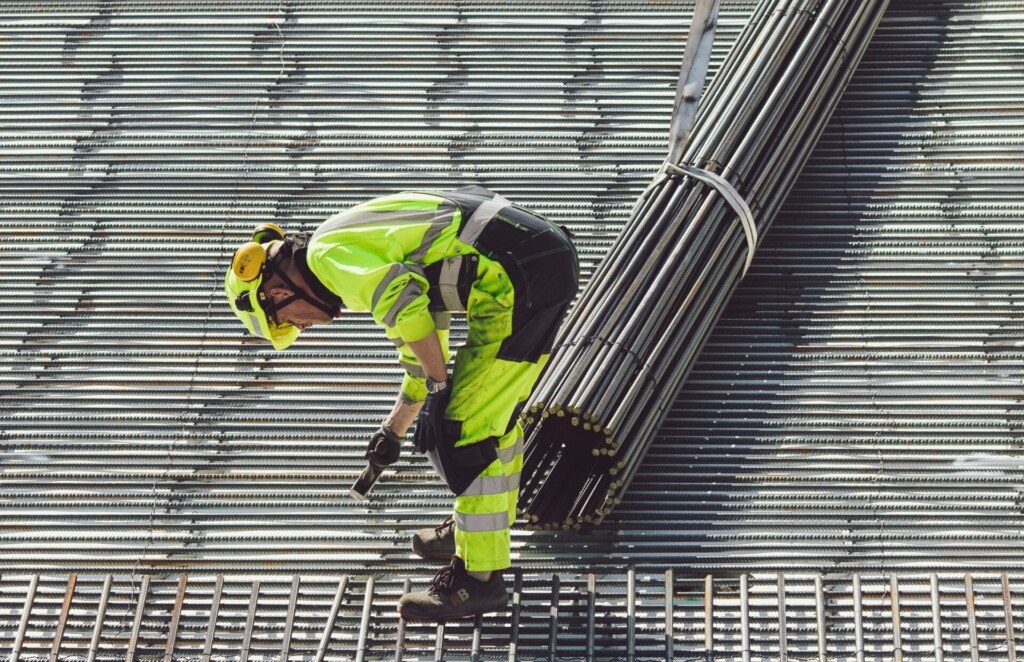
Steel-frame commercial construction remains the benchmark for developers and property owners seeking reliable performance across multiple criteria. We deliver structures that achieve spans from 40 feet to over 300 feet while maintaining the fire resistance and seismic performance required by modern building codes. With high recycled content and full recyclability, steel systems are well positioned for future environmental regulations and circular-economy initiatives.
Successful decisions depend on a systematic evaluation of three core areas. First, match structural systems to occupancy types and environmental loads, whether designing for hurricane uplift resistance in coastal zones or seismic energy dissipation in active regions. Second, leverage prefabrication and modular approaches to compress schedules by 30-50% while improving quality control in factory-controlled conditions. Third, integrate BIM early to optimize member sizing, detect clashes, and coordinate lateral systems with service-integration requirements.
Moving forward requires coordination between structural design and operational flexibility. Define loads and deflection criteria during conceptual design, establish clear-span planning that accommodates future reconfigurations, and select connection types that balance initial economy with long-term adaptability. We recommend engaging structural engineers who are familiar with modern steel alloys and demountable connection systems to maximize both immediate performance and future value retention.
Ready to explore how steel-frame commercial construction can support your next project? Contact EB3 Construction to discuss your specific requirements and timeline.