Modern vehicles undergo millions of miles of testing before reaching consumers, which requires sophisticated facilities supporting everything from crash simulation to tire durability programs. An automotive testing facility contractor plans and delivers specialized spaces for research, development, and validation at industrial scale.
These facilities integrate vehicle testing zones, engineering labs, and collaborative office areas to accelerate product development cycles. We coordinate the infrastructure to support crash and sled testing, tire performance evaluation, and barrier testing within secure, adaptable environments designed for current programs and future expansion.
Which Test Spaces And Specialty Equipment Shape The Program?
Vehicle testing facilities require specialized labs and testing bays tailored to specific validation programs. Each space enables distinct testing capabilities that support prototype assembly, component validation, and full-scale vehicle evaluation.
Crash Testing Halls
Crash halls feature MESSRING equipment, considered the industry gold standard for precision and accuracy. These systems include propulsion systems, MicroTrack rails, and impact zones that accommodate frontal, side, and offset testing configurations. The near-zero clearance between the rails and tow trolleys provides superior control over test vehicles and precise speed management up to 120 kilometers per hour.
Modern crash halls incorporate multiple impact zones within a single facility, allowing simultaneous testing of different crash scenarios. Photo pits measuring up to 6 meters by 4 meters capture expansive underbody footage during impact events. Load cell walls provide force measurements in multiple directions, delivering critical data for crash simulation model validation.
Sled Testing Laboratories
Sled labs house ServoSled systems with force capacities ranging from 1.0 MN to 3.1 MN. These systems enable pulse matching for severe crash scenarios and support testing in any direction or angle required by specific programs. The equipment performs regulatory pulses for seats, child restraints, seatbelts, and battery systems, as well as complex frontal vehicle pulses.
ServoSled systems offer on-demand pulse matching that minimizes downtime between test requirements. The technology supports everything from component-level tests to full occupant safety system validation, with payload capacity sufficient for large battery packs and complete seating assemblies.
Tire Performance Testing Areas
Tire performance areas require high-force flat-track machines capable of generating significant loads for comprehensive tire evaluation. These spaces support testing protocols that examine tire behavior under various speeds, loads, and environmental conditions. The equipment enables data collection for tire development programs focused on performance, durability, and safety characteristics.
Barrier And Bollard Impact Zones
Dedicated impact zones for barrier and bollard testing provide controlled environments for evaluating protective systems. These areas accommodate testing to international standards and allow validation of barrier performance under specified impact conditions. The zones include appropriate approach distances and safety systems to contain impact forces and debris.
Private Customer Work Areas And Storage
Private customer work areas integrate directly with vehicle preparation rooms, providing secure access to test vehicles while maintaining confidentiality. These spaces include storage for test articles, components, and associated equipment. Badge-controlled access systems ensure separation between different customer programs, allowing multiple manufacturers to conduct testing simultaneously while protecting proprietary information.
Storage areas accommodate various vehicle sizes and testing equipment, with integrated shipping and receiving docks for secure vehicle handling. Climate-controlled environments maintain consistent temperatures ideal for instrumentation and crash-test dummy storage.
Environmental And Network Testing Facilities
Climatic testing chambers support temperature, humidity, and altitude simulation requirements for component and vehicle validation. These controlled environments enable testing under extreme conditions that vehicles may encounter in service. Acoustic testing areas provide sound isolation for noise, vibration, and harshness evaluation programs.
Network facilities support connected vehicle testing and validation of communication systems. These areas include equipment for testing vehicle-to-infrastructure and vehicle-to-vehicle communication protocols under controlled laboratory conditions.
Layout Considerations For Operational Efficiency
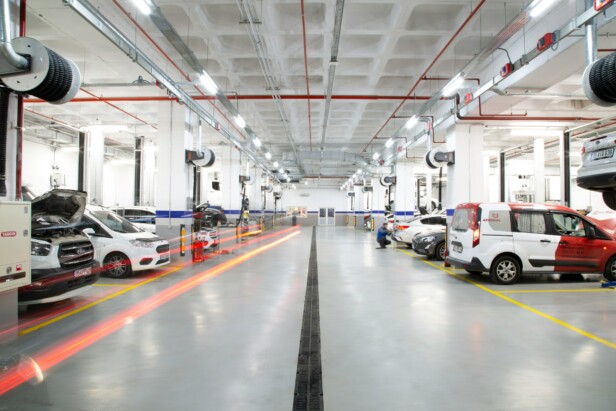
Facility layouts prioritize fast reconfiguration and the safe movement of vehicles and components. Wide corridors and appropriate turning radii accommodate vehicle transport between testing areas. Modular design elements allow spaces to adapt to changing testing requirements without major construction.
Equipment positioning prioritizes workflow efficiency, with instrumentation calibration and preparation areas strategically located near testing bays. The layout integrates safety systems and emergency protocols throughout the facility to protect personnel and equipment during high-energy testing events.
How Should Structure And MEP Be Designed For High Loads And Rapid Changeovers?
We prioritize load capacity, vibration control, and rapid reconfiguration in structural and MEP design. Heavy testing equipment creates static loads and dynamic forces that exceed typical building requirements. Our process ensures systems can handle these demands while supporting quick changeovers between test programs.
Structural Foundation Requirements
Reinforced slabs form the backbone of testing facilities. We design concrete slabs with enhanced steel reinforcement and increased thickness to distribute heavy equipment loads across larger areas. Dynamic floor-loading calculations account for impact forces from crash testing, sled systems, and vehicle movement.
Vibration-resistant structural design isolates sensitive testing areas from operational disturbances. We incorporate structural isolation joints, damping systems, and mass concrete elements to minimize vibration transfer. This approach protects precision instruments and maintains measurement accuracy during simultaneous testing operations.
Flexible Floor Systems
Flush-mounted lifts integrate into floor systems without creating trip hazards or workflow interruptions. We coordinate lift placement with structural reinforcement to handle concentrated loads while maintaining smooth traffic flow. Proper installation requires precise MEP coordination for hydraulic lines and electrical connections.
Dynamic floors support rapid bay reconfiguration through modular panel systems and embedded utility access points. These floors distribute loads effectively while allowing quick access to compressed air, electrical, and data connections. The modular design enables testing configurations to change without major construction.
Embedded Utility Infrastructure
Clean utilities are embedded throughout test zones to support diverse equipment needs. Compressed air systems require dedicated lines with moisture separation and pressure regulation at each connection point. We design these systems with redundancy to prevent testing delays from utility failures.
High-voltage charging infrastructure supports electric vehicle testing with 480V and higher connections strategically placed throughout testing areas. Proper electrical design includes isolation switches, ground-fault protection, and load monitoring. Fluid management systems handle hydraulic fluids, coolants, and waste streams with containment and recovery capabilities.
Environmental Control And Power Systems
HVAC systems must accommodate environmental chambers operating at extreme temperatures and humidity levels. We design dedicated air-handling units with precise control capabilities and isolation from standard building systems. Equipment tie-ins require coordination between chamber manufacturers and our MEP systems.
Heavy electrical loads from testing equipment demand robust distribution systems with adequate capacity and protection. We provide multiple power feeds, voltage regulation, and monitoring systems to support continuous operations. Equipment coordination ensures proper grounding and electromagnetic compatibility.
Intelligent Building Management
IoT-enabled building management systems centralize control of lighting, HVAC, security, and equipment monitoring. These systems provide real-time feedback on facility performance and enable remote monitoring of critical parameters. Integration with testing equipment allows coordinated responses to operational demands.
System monitoring tracks energy consumption, environmental conditions, and equipment status across all testing areas. Automated alerts notify operators of system issues before they impact testing operations. Data collection supports continuous improvement and predictive maintenance strategies.
What Integration, Data, And Security Features Matter During Delivery?

We begin with preconstruction planning to identify every equipment interface, power requirement, and system integration point before breaking ground. This coordination prevents costly field changes and ensures vendors can deliver on schedule.
Preconstruction Planning and Vendor Coordination
Constructability reviews examine how specialized equipment fits within structural and MEP systems. We work directly with testing equipment manufacturers to confirm mounting requirements, power loads, and clearance needs. This process identifies potential conflicts between crash barriers, sled systems, and building infrastructure early in the design.
Our teams coordinate closely with vendors on delivery schedules and installation sequences. Equipment such as MESSRING crash systems or ServoSled units require precise timing with structural work and utility installation. We manage these dependencies through detailed project phasing that prevents delays.
Phased Equipment Testing and Risk Reduction
We implement phased equipment testing to validate systems before full facility operations begin. Each testing bay undergoes individual commissioning to verify that power, controls, and safety systems function correctly. This approach reduces risk by catching issues while corrections remain manageable.
Testing phases progress from verifying basic utilities to full equipment operation under simulated conditions. We document every test result and system performance metric to establish baseline operations. This data becomes critical for ongoing facility monitoring and maintenance planning.
Centralized Controls and Facility Monitoring
Building automation systems centralize control of lighting, HVAC, security, and monitoring of specialized equipment. We integrate these systems to provide real-time feedback on facility conditions and equipment status. Operators can monitor multiple testing bays from a single control room.
This centralized approach supports both safety and efficiency. Automated shutdowns protect equipment and personnel during emergencies. Remote monitoring capabilities allow facility management to track energy consumption, equipment performance, and environmental conditions across all testing areas.
Secure Work Areas and Data Protection
We design secure, private work areas where clients can conduct confidential testing programs without exposure to other facility users. These zones feature controlled access, isolated networks, and physical barriers to protect sensitive prototypes and test data.
Some automotive testing facilities require alignment with information security frameworks like TISAX, which establishes data security standards for the automotive industry. We coordinate with facility operators to ensure physical security measures, network isolation, and access controls meet these requirements. This attention to confidentiality protects intellectual property and supports client trust in sensitive testing programs.
How Do Test Standards and Methods Guide Facility Specifications?
When we design automotive testing facilities, specific test standards and methods shape every aspect of the building program. These requirements determine chamber dimensions, environmental controls, structural systems, and safety protocols.
Environmental and Durability Testing Standards
Environmental chambers must accommodate standards like SAE J2527 for weathering protocols and DIN ISO 75220 for solar simulation testing. SAE J2527 drives chamber sizing for accelerated weathering cycles that test material degradation under controlled temperature, humidity, and UV exposure. These standards require precise temperature control systems, specialized lighting arrays, and specimen mounting hardware.
DIN ISO 75220 solar simulation protocols demand chambers with metal halide lamp arrays that replicate global solar radiation spectra. We size these spaces to accommodate test articles ranging from individual components to complete vehicle interiors. This range requires chambers with clearances up to 15 feet and integrated specimen rotation systems.
Fire Safety and Material Compliance Standards
Fire and material flammability standards directly influence laboratory safety systems and ventilation design. FMVSS 302 testing for automotive interior materials requires specialized combustion chambers with controlled airflow, exhaust scrubbing, and emergency suppression systems. These labs need dedicated fume extraction, fireproof specimen storage, and rapid emergency shutdown protocols.
DIN 75200 flammability requirements shape how we design material testing bays with reinforced containment areas and automated fire suppression. The testing apparatus requires precise gas flow controls, temperature monitoring, and specialized exhaust treatment to handle combustion byproducts safely.
OEM and Supplier Specifications
Automotive manufacturers impose specific testing requirements that drive facility programming. VOC and odor testing protocols like PV 3900 for Volkswagen require sealed environmental chambers with precise contamination controls and analytical equipment integration. These spaces need ultra-clean HVAC systems, specialized air sampling ports, and adjacent analytical labs for gas chromatography equipment.
GMW 15634 specifications from General Motors establish requirements for emissions testing that influence chamber design, background contamination controls, and analytical area layouts. We program these facilities with temperature-controlled specimen conditioning areas, automated sampling systems, and integrated data collection networks.
Vibration Testing Infrastructure Requirements
Vibration testing standards for automotive components, particularly lighting assemblies and electronic systems, drive significant structural and electrical design decisions. These testing setups require isolated foundation systems that eliminate external vibration transmission and specialized power conditioning for electrodynamic shakers.
Structural isolation systems for vibration labs often require independent foundations extending below the main building slab, with floating floors and vibration-damped utility connections. Electrical systems must provide clean power with precise frequency control and adequate capacity for high-force shaker systems that can exceed 100 kVA during test cycles.
Compliance Mapping and System Integration
Early standards mapping ensures facility compliance and operational readiness from day one. We coordinate each testing standard with specific room requirements, utility loads, and control system capabilities during programming phases. This process identifies conflicts between different testing protocols and establishes priority systems for shared resources like compressed air, electrical capacity, and environmental controls.
Standards compliance drives the building management system architecture, establishing monitoring requirements for temperature logging, airflow verification, and equipment performance tracking. These systems provide real-time compliance verification and automated documentation for audit protocols required by automotive OEM qualification processes.
Conclusion And Next Steps
Automotive testing facilities demand robust infrastructure to support crash testing, sled validation, tire performance evaluation, and environmental simulation. These specialized environments rely on reinforced structural systems, adaptable floor configurations, embedded utilities, and intelligent building automation to deliver safe, efficient operations. Together, these elements enable facilities to handle high-impact crash scenarios and precise environmental chamber control.
Moving forward with your automotive testing facility project requires a systematic approach across five critical areas. Define your test portfolio and applicable standards first, aligning with requirements such as FMVSS No. 302, DIN 75200, and any client-specific protocols. Program each laboratory and testing bay to accommodate specialized equipment loads and operational workflows. Plan structural and MEP systems for dynamic loads and rapid reconfiguration. Integrate building automation systems to centralize monitoring and control. Finally, implement phased vendor commissioning to verify that all systems meet specifications before full operational deployment.
Ready to develop a comprehensive automotive testing facility that meets your validation requirements? Contact EB3 Construction to discuss your project scope and technical specifications.