How a project is structured before construction begins determines how risk, cost, and accountability are distributed across every phase that follows.
Design-build has become one of the most widely adopted delivery methods in commercial construction precisely because it consolidates those variables under a single contract; but understanding when it fits, how it works, and what trade-offs it carries is what allows owners to make the decision with confidence.
What Is Design-Build Construction and When Does It Make Sense for Your Project?
Contract Structure: One Agreement Versus Two
The most direct distinction between the two delivery models lies in the contract structure. Design–build consolidates design and construction under a single agreement with one entity, giving the owner a clear, unambiguous point of contact throughout the project. Design–bid–build splits those responsibilities across two separate contracts: one with a designer and one with a general contractor, with the owner acting as the link between them.
That owner-in-the-middle position has real consequences. When a design issue surfaces during construction in a design–bid–build arrangement, the owner often ends up arbitrating disputes between parties who hold no contractual obligation to each other. Risk for design completeness sits squarely with the owner, not the contractor building from those documents.
Schedule Overlap and Timeline Differences
Design–bid–build follows a linear sequence: design reaches full completion, bids go out, a contractor is selected, and construction begins. Every phase waits for the previous one to close. A delay in design ripples through and pushes every subsequent milestone.
Design–build removes that hard stop. Because design and construction operate under the same contract, sitework, foundation work, or other early-phase construction can begin before the full design is finalized. This phase overlap is one of the most operationally significant differences between the two methods, particularly on larger or time-sensitive projects. According to research cited by Penn State, design–build projects were delivered approximately 33% faster overall and cost roughly 6% less than comparable design–bid–build projects.
A University of Texas study examining U.S. Naval facility projects found consistent results: design–build projects took less time, experienced lower cost growth, and came in less expensive to build than their design–bid–build counterparts.
| Aspect | Design–Build | Design–Bid–Build |
|---|---|---|
| Contract Structure | Single contract | Separate contracts |
| Timeline | Overlapping phases | Sequential phases |
| Owner Risk | Less risk on owner | More risk on owner |
| Change Orders | Fewer change orders | More change orders |
| Cost Performance | Generally lower cost | Higher cost potential |
Risk Transfer and Change Order Exposure
Under design–bid–build, contractors bid only on what is explicitly documented. Gaps, ambiguities, or errors in the design documents become change orders, and those change orders carry cost and schedule implications that typically land back on the owner. A study by the Construction Industry Institute (CII) found that design–build projects had a 6% reduction in change orders compared to design–bid–build, a meaningful difference across large-scale capital programs.
Risk transfer works differently in design–build because the design–builder is contractually responsible for both the completeness of the design and the quality of construction. That contractual obligation removes the owner from the position of warranting the design documents and mediating interpretation disputes between separate teams.
Competitive Bidding and Owner Control
Design–bid–build preserves a competitive bidding process. Multiple contractors price the work against the same complete set of documents, giving owners pricing leverage and clear comparison points. For straightforward projects or public procurements that require open competition, that structure has genuine value.
Design–build trades some of that price competition for schedule certainty and integrated accountability. Owners select the design–build team based on qualifications and approach rather than lowest bid, which means the selection process demands more scrutiny upfront. Owners who prefer to retain direct control over design decisions and vendor selection at each stage will generally find design–bid–build a more comfortable fit.
Who Leads And What Roles Exist In Design-Build?
The design-builder can take several forms: a general contractor, an architect or engineer, a developer, or a joint venture between two or more firms may hold the prime contract. The entity that signs the contract is the one the owner holds accountable for cost, schedule, and performance, regardless of how the internal team is structured.
Two team configurations are most common in practice: contractor-led design-build and architect-led design-build. Each assigns leadership differently, but both preserve the single point of accountability that defines the delivery method.
Contractor-Led Design-Build
In a contractor-led arrangement, the general contractor holds the prime contract directly with the owner. The A/E (architect/engineer) joins the team in one of several ways: as an employee of the contracting firm, as a subcontractor retained by the GC, or as a joint venture partner sharing risk and revenue. The construction firm drives preconstruction planning, coordinates subcontractors, and manages the overall schedule.
This structure is more common, particularly on commercial, industrial, and infrastructure projects. Because the contractor controls procurement and construction sequencing from the start, cost modeling tends to be integrated early into design decisions. The practical consequence is that buildability and budget alignment shape the design from the first milestone rather than after drawings are complete.
One trade-off noted in industry research is that design quality can receive less emphasis when the team is contractor-led because the A/E operates in a subordinate role. Owners with specific performance or aesthetic requirements should address this directly in the contract by defining design quality standards and review checkpoints.
Architect-Led Design-Build
In an architect-led structure, the design firm holds the prime contract and takes on full accountability for both design and construction delivery. The architect may bring a general contractor into the team as a subcontractor, form a joint venture with a construction firm, or build out a sister construction entity to manage field operations. Subcontractors are typically retained and managed through that construction entity or joint venture partner.
Historically, this was the original model. Engineers and architects once carried responsibility for the entire project, from concept through construction. That tradition faded as legal and liability structures shifted, but architect-led design-build has been gaining renewed interest, particularly on projects where design intent and long-term performance are primary owner priorities.
What Are The Typical Steps In A Design-Build Process?
Team Selection And Preconstruction Planning
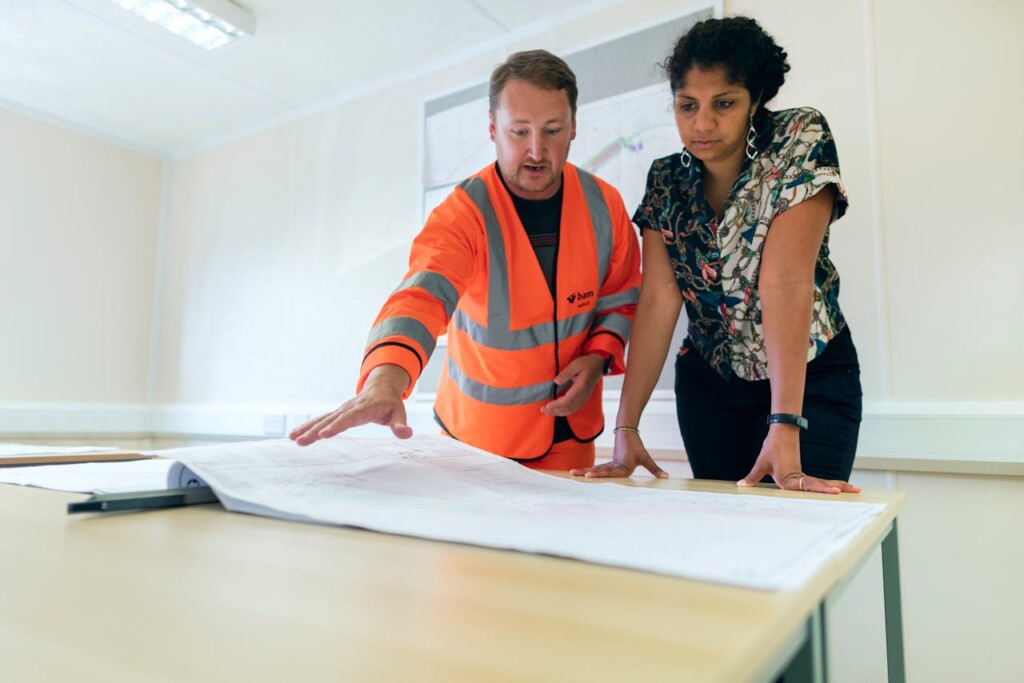
The design-build process begins with selecting a team based on qualifications, relevant experience, and project fit rather than the lowest bid. Owners typically issue a draft request for proposal (RFP) to shortlisted firms, giving proposers an opportunity to ask questions and clarify scope before final submissions are reviewed. Because the design-builder carries single-source accountability, that decision holds more weight than in conventional delivery methods.
Once a team is engaged, preconstruction planning gets underway. This phase confirms project goals, identifies site constraints, reviews code-compliance requirements, and surfaces risks before any design work advances. Business and financial analyses, architectural and mechanical system assessments, and jobsite evaluations all take place here, building a clear foundation for every decision that follows.
Early Design, Cost Modeling, And BIM/VDC
With preconstruction groundwork established, the team moves into early design and cost modeling. Building Information Modeling (BIM) and Virtual Design and Construction (VDC) tools generate three-dimensional representations of the project at this stage, giving the owner a concrete visual reference tied directly to early budget and schedule data. This early collaboration offers measurably better insights into project design, scope, budget, and timeline than approaches where design and construction teams work separately.
Cost estimates are typically produced at 30%, 60%, and 90% design completion, allowing owners to evaluate how design decisions affect price in real time. This continuous cost modeling reduces the likelihood of budget surprises as the project progresses toward a guaranteed maximum price (GMP). The overlap between design development and cost validation is one of the structural advantages that separates design-build from sequential delivery methods.
Collaborative Design Development And Contract Finalization
During collaborative design development, the design-build team and owner work together to refine conceptual drawings into detailed schematics. Performance requirements are defined, owner input is incorporated directly into design decisions, and key subcontractors may be engaged early to provide constructability feedback. This iterative process reduces costly revisions later by resolving design conflicts while changes are still inexpensive.
Contract finalization follows once scope, schedule, and price reach a defined level of certainty. At this point, the design-builder and owner agree on a final contract cost that reflects the established design documents. The contract should clearly define each party’s roles, owner approval milestones, change management procedures, and dispute resolution steps to protect both sides as the project moves into construction.
Construction, Subcontracting, And Project Closeout
During the construction phase, the design-build team manages subcontracting, daily scheduling, and progress reporting under one organizational structure. The owner maintains a single point of contact throughout, which streamlines communication and eliminates the coordination gaps that occur when designers and builders operate under separate contracts. Quality control remains a shared responsibility across the integrated team rather than a function handed off between parties.
Sitework coordination, procurement, and field execution all run through the same team that developed the design, which means problems are resolved faster and with less friction. The design-builder monitors budget, schedule, and performance metrics continuously, reporting back to the owner with unified data rather than competing narratives from separate firms.
Project closeout in a design-build structure is typically more straightforward than in traditional delivery methods because all documentation, warranties, as-built drawings, and operational manuals reside with a single team. The post-construction review consolidates this information and transfers it to the owner in a single handoff. Because one entity managed every phase, the closeout package reflects a coherent record of the entire project rather than fragmented documentation assembled from multiple sources.
What Benefits, Risks, And Use Cases Should You Weigh?
The Case for Design-Build: Operational Advantages
Early cost clarity stands out as one of the strongest operational arguments for design-build. Because the design and construction team works together from the beginning, pricing is informed by real-time construction data rather than estimates based on historical bid tabulations. That alignment reduces the gap between what an owner budgets and what a project ultimately costs.
Fewer changes and claims follow naturally from that integrated structure. When designers and builders share accountability under one contract, disputes over design errors or construction conflicts are resolved within the same team. The Design-Build Institute of America has documented consistent reductions in cost and schedule growth for design-build projects compared to traditional delivery. Reduced litigation is a practical outcome of that shared risk structure, not just a theoretical benefit.
Value engineering also starts earlier under design-build. Rather than reviewing a completed design for cost-saving opportunities, the construction team contributes constructability input during the design phase itself. That early involvement can surface material alternatives, sequencing efficiencies, and subcontracting strategies before they become costly to change.
Risks Worth Acknowledging Before You Commit
Reduced competitive bidding is the most cited trade-off. When one integrated team handles both design and construction, the owner bypasses the open market competition that design-bid-build relies on for price validation. That creates a dependency on the procurement structure to establish value rather than low-bid competition.
Selection subjectivity presents a related challenge. Qualifications-based selection, which design-build often relies on, requires the owner to evaluate team fit, design approach, and past performance rather than simply comparing prices. Owners without internal expertise in evaluating design-build proposals may find the process more difficult to navigate and to justify to stakeholders.
There are also scope control considerations. In traditional design-build, the owner defines performance requirements upfront, and the design-builder locks in a price based on those requirements. If the owner’s vision shifts after contract award, adjustments can be costly. Projects with highly specific aesthetic requirements or complex programming needs may encounter friction when the contractually compliant design does not fully match what the owner envisioned, as noted in CMAA research documenting cases where transit station finishes met contract criteria but fell short of owner expectations.
Procurement Options That Help Manage Risk
Two-step best-value procurement offers a structured way to filter the market before price becomes the deciding factor. In the first step, owners shortlist teams based on qualifications and a conceptual technical approach. In the second step, shortlisted teams submit detailed proposals with cost and schedule commitments. This approach preserves some competitive tension while giving the owner sufficient design development to make a well-informed award decision.
Progressive design-build takes that logic further by deferring the final price until the design has advanced sufficiently to reduce unknowns. The owner selects a team based primarily on qualifications, then collaborates through a pre-construction services phase to develop scope, identify risks, and refine cost estimates before committing to a guaranteed maximum price. According to CMAA research, progressive design-build teams are more likely to formally address permitting risk, third-party agreements, and scope constraints before pricing is finalized, which reduces blind spots that can drive contingency inflation in traditional design-build.
Progressive design-build does require more owner involvement and internal staffing capacity, particularly during the early design and pre-construction phase. That investment can be offset by fewer risk-driven contingencies and change orders later in the project, but owners need to enter the process prepared to participate actively rather than hand off responsibility at contract award.
Matching the Delivery Method to the Project
Design-build performs well on projects with well-defined performance requirements and standardized scope elements. Roadway improvements, utility infrastructure, warehouse construction, and ground-up commercial buildings with clear functional criteria are strong candidates. The design-builder can work efficiently within established parameters, and the single-contract structure produces schedule and cost advantages without introducing scope uncertainty.
Projects with significant unknowns, complex stakeholder environments, or limited existing design criteria benefit more from progressive design-build. A wastewater treatment plant expansion, a transit station renovation, or any project that requires extensive permitting, utility coordination, or community input before scope can be finalized fits this profile. The phased pricing structure allows the owner and design-builder to address those variables collaboratively rather than pricing around them with large contingencies.
Architect-led design-build structures are worth considering when design quality and aesthetic outcomes are central to the project’s value. In those arrangements, the architect leads the integrated team and maintains design control through construction, which can close the gap between the owner’s vision and the delivered result. The structure still provides single-point accountability, but with design development driving the process rather than construction efficiency alone.
| Aspect | Design-Build | Two-Step Best-Value Design-Build | Progressive Design-Build |
|---|---|---|---|
| Selection Basis | Based on cost and qualifications | Qualifications and past performance heavily weighted initially; design and price evaluated later | Primarily qualifications-based |
| Pricing Timing | Determined early in the process | Firm-fixed-price provided at contract award | Price finalized after design has progressed |
| Owner Involvement Level | Limited input during design | Focused on establishing project goals before award | Extensive input during early design phase |
| Risk Profile Suitability | More fixed and less adaptable; limited risk sharing | Offers certainty with an early price but includes contingencies | Suitable for projects with many unknowns and shared risk management |
| Ideal Project Types | Standardized or straightforward projects | Projects with clear scopes and high-quality requirements | Complex projects with evolving requirements and extensive permitting |
Conclusion And Next Steps

Design-build consolidates design and construction under one contract, placing full accountability with a single entity. That structure drives faster coordination, earlier cost clarity, and fewer disputes throughout the project lifecycle.
Selecting the right procurement path requires honest internal assessment. If your team can draft a clear, non-prescriptive RFP with defined performance requirements and an achievable budget, two-step best value gives you competitive proposals and a firm price at contract award. If your project carries significant unknowns or your stakeholders need to see design details before committing to scope, progressive design-build allows owner requirements and pricing to develop together through a phased, collaborative process. As DBIA’s Design-Build Done Right® principles make it clear, the right choice depends on the owner, the project, and the team’s capacity to collaborate at every level.
Once the procurement direction is set, the contract work begins. Clearly define the roles of the design professional of record, establish milestone requirements for design commitment phases, substantial completion, and final payment, and build in an efficient change process before the first shovel breaks ground. Subcontractor engagement should occur early in this sequence. Key trade partners brought in during design contribute constructability input, accurate cost modeling, and scheduling insight that would otherwise surface too late to address.
At EB3 Construction, we approach every design-build engagement with this sequence in mind, from initial goal-setting through subcontractor coordination and contract structuring. Contact us to discuss how we can support your next project.