Most bar and lounge projects fail before a single wall goes up; not because of poor design, but because the contractor responsible for the full build-out underestimates what code compliance demands from day one.
We manage the complete transformation from empty shell to certificate of occupancy—coordinating design, structural work, MEP installations, occupant load planning under NFPA 101, means of egress design, and life safety systems—to satisfy the fire marshal and health department at every phase.
How Is Occupancy Load Planned For A Bar And Lounge?
Identifying Areas And Applying The Right Factors
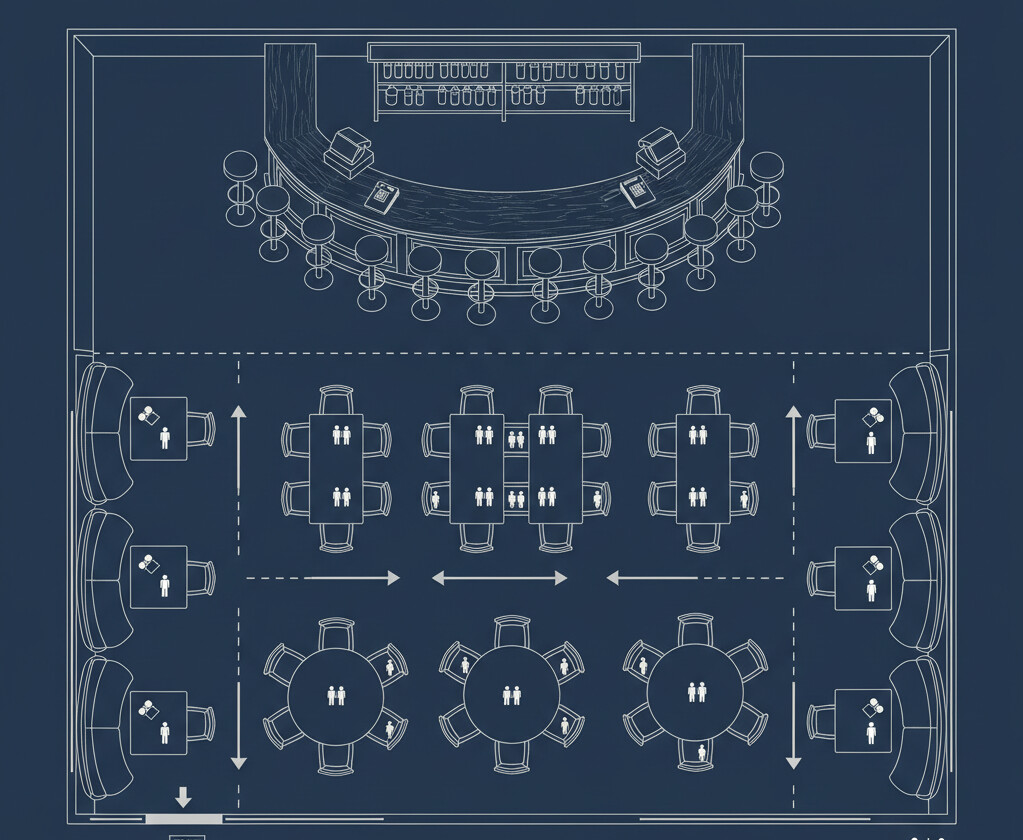
Every occupant load calculation under NFPA 101 Table 7.3.1.2 begins by breaking the space into functional zones. For a bar and lounge, that means separating the dining area, bar seating, dance floor, kitchen, and storage before any calculations are performed. Each zone carries its own occupant load factor, and mixing them together produces an inaccurate result that can trigger the wrong code requirements or, worse, leave the space underprotected.
Once the zones are defined, the correct factor is applied to each. Dining areas with tables use 15 net square feet per person, reflecting the space taken up by furniture. Standing bar areas and dance floors use 7 net square feet per person, the concentrated assembly use factor that accounts for higher crowd density. Kitchen areas use 100 square feet per person. These factors are not interchangeable, and applying the wrong factor to a standing bar area, for example, would significantly undercount the occupant load.
Net area calculations require subtracting non-occupiable space before dividing by the factor. Permanent fixtures like the bar structure itself, pool tables, storage rooms, columns, and restrooms cannot be occupied, so they come out of the total before the calculation is done. After each zone is calculated separately, the results are summed to produce the total preliminary occupant load for the venue.
Density Limits and Occupancy Caps
NFPA 101 sets hard density limits that act as a ceiling on occupant load regardless of what the zone-by-zone calculation produces. For assembly spaces under 10,000 square feet, the limit is one person per 5 square feet. For spaces over 10,000 square feet, the limit drops to one person per 7 square feet. These thresholds exist because beyond a certain crowd density, efficient egress breaks down and occupant behavior becomes unpredictable, which NFPA refers to as the jam point.
When a preliminary occupant load calculation exceeds these density limits, the load must be reduced to the density cap. This is a common scenario in smaller bars and lounges where the zone-by-zone math produces a high number relative to the total footprint. We factor these limits into the layout planning phase so that the posted occupant load reflects what the space can safely handle, not just what the square footage arithmetic suggests.
How Occupant Load Drives Exit Requirements
The total occupant load is the number that determines how many exits are required and how wide they must be. Under NFPA 101, a venue with 50 to 500 occupants requires at least two exits. A load between 501 and 1,000 requires three, and anything above 1,000 requires four. These counts are independent of egress-width calculations, so a space must satisfy both the number and width requirements.
Exit width is calculated using capacity factors from NFPA 101 Table 7.3.3.1. For level egress components such as doors and ramps, the factor is 0.2 inches per person. For stairs, it increases to 0.3 inches per person. A venue with a calculated occupant load of 400 people, for example, needs at least 80 inches of level egress width distributed across its exits. Stairs require proportionally more width, which makes them potential pinch points if the stair configuration was not sized with the occupant load in mind.
Main entrance and exit capacity adds another consideration. NFPA 101 requires the main entrance to accommodate at least 50% of the total occupant load. For nightclubs, dance halls, and discotheques specifically, that threshold rises to 66%. This distinction matters during design because the main entrance door width, swing direction, and hardware must all be sized to meet that percentage before the remaining exits handle the balance.
What The Final Load Number Triggers
The occupant load figure that comes out of this process is not just a number posted for the fire marshal. It directly activates specific code requirements across the build-out. Sprinkler thresholds, fire alarm requirements, panic hardware obligations, and door swing direction are all tied to occupant load milestones. We track these triggers from the earliest design stage so that structural framing, electrical rough-in, and plumbing layouts are already sized for the systems the final load number will require.
Doors serving more than 50 occupants must swing in the direction of egress travel. Doors serving 100 or more occupants that include a latch or lock must have approved panic hardware. These are not finish phase details; they affect door frame sizing, hardware specifications, and rough-in coordination well before walls are closed. Getting the occupant load right at the start of design keeps those downstream decisions accurate and avoids costly revisions during permit review or final inspection.
Which Life Safety Systems Are Required For Bars And Lounges?
Fire Sprinkler Systems
Sprinkler requirements for bars and lounges follow two distinct triggers under NFPA 13. Any venue classified as a nightclub, dance hall, or discotheque must have a fully automatic sprinkler system regardless of its occupant load. For standard bars and lounges that do not fall into those categories, sprinklers become mandatory once the total occupant load exceeds 300.
Coverage cannot be selective. Sprinkler heads must extend through every occupied and service area, including the dining floor, bar counter zones, kitchen, and all storage rooms. Gaps in coverage create both code violations and real fire risk, particularly in back-of-house areas where combustible materials accumulate.
Following 2003 code revisions many jurisdictions lowered sprinkler thresholds for nightclub-type occupancies to approximately 100 occupants. Some state amendments, including Florida’s fire prevention code, reflect this lower threshold for dance halls, discotheques, nightclubs, bars, and restaurants. We verify the applicable local amendments before finalizing the sprinkler scope on every project.
Fire Alarm Systems
A complete fire alarm system is required for any assembly occupancy with an occupant load of 300 or more. The system must be installed in compliance with NFPA 70 (National Electrical Code) and NFPA 72 (National Fire Alarm and Signaling Code). In a bar or lounge, voice evacuation is critical, providing clear, intelligible direction during an emergency rather than relying on tones alone.
Alarm signals must transmit to a constantly attended location while the building is occupied. When that is not practical, the authority having jurisdiction (AHJ) can require monitoring through an approved off-site supervising station. We coordinate this requirement with the fire marshal early in the design phase to avoid last-minute system changes before final inspection.
Means of Egress
The occupant load calculated in the previous section directly determines egress requirements. Exit count, door widths, and travel distances must all accommodate the posted capacity. Doors along the egress path must swing in the direction of egress travel, and any door serving an assembly occupancy above the applicable occupant threshold must be equipped with panic hardware to allow immediate, unobstructed exit.
Every egress route must remain clear, well-lit, and marked with illuminated exit signs. Emergency lighting is required so that occupants can navigate to exits if normal power is lost. These are not optional finishes; they are code-mandated systems that building and fire inspectors check during final walkthroughs.
Hazardous Area Protection
NFPA 101 identifies specific areas within a building as hazardous based on the materials stored or equipment operated there. In a bar and lounge build-out, this typically includes combustible storage rooms, boiler and furnace rooms, electrical transformer rooms, and any space used for storing flammable or combustible liquids. Each of these areas requires either a minimum one-hour fire-resistance-rated separation from the rest of the building or protection by an automatic fire-extinguishing system.
Spaces that combine both elevated combustibility and operational risk, such as rooms used for processing flammable liquids, must meet both requirements simultaneously: one-hour rated construction and an automatic fire-extinguishing system. We identify all hazardous area classifications during the design coordination phase so that framing, rated assemblies, and suppression rough-ins are sequenced correctly from the start.
Kitchen Ventilation and Hood Fire Suppression
Commercial kitchen equipment in a bar or lounge setting produces grease-laden vapors that present a distinct fire hazard. Under NFPA 96, all commercial cooking equipment must be installed beneath a listed hood and duct system. A fire-extinguishing system must be integrated within the hood itself, and the exhaust duct system must actively remove flammable vapors from the cooking area.
The suppression system inside the hood protects the grease removal devices, the hood exhaust plenum, and the exhaust duct. Any additional equipment installed within the exhaust duct, such as air pollution control devices or thermal recovery units, requires its own automatic fire-extinguishing coverage. Kitchen ventilation and hood suppression are among the systems that fire marshals and health departments review, making proper installation and documentation essential for certificate of occupancy approval.
What Does The Bar And Lounge Build-Out And Permitting Path Look Like?
The Two-Track Build-Out Process
Every bar and lounge build-out we manage runs on two parallel tracks: design and construction. Both must stay coordinated from the first day of space assessment, where we evaluate layout possibilities, map flow patterns, identify kitchen equipment needs, and flag the code requirements that shape every subsequent decision.
Once permits are secured, construction follows a defined sequence. We begin with selective demolition to clear and prepare the space, then proceed to structural modifications for any new openings or load-bearing changes the layout requires. This sequence keeps the site organized and prevents rework that drives up costs later.
MEP rough-in follows structural work, and coordination is precise. Mechanical systems must support hood ventilation capacity, electrical service must handle commercial kitchen and bar loads, and plumbing infrastructure must accommodate three-compartment sinks and grease trap connections. Framing and finishes close out the construction sequence while maintaining egress clearances and accessibility compliance throughout.
The Permitting Sequence
Permitting begins with zoning verification. Before any drawings are submitted, we confirm that the intended bar and lounge use aligns with local ordinances. Zoning reviews can involve community boards, wet-zone surveys for liquor licensing, or architectural review committees depending on the jurisdiction, so we never assume approval.
Building permit applications follow, with complete construction drawings that detail structural, architectural, and life-safety systems. MEP permits are filed separately for mechanical, electrical, and plumbing work, each carrying its own review timeline. We coordinate these submissions in parallel to avoid scheduling gaps that could stall construction.
Health department approvals typically take the longest. Reviewers scrutinize kitchen layout drawings, equipment specifications, and ventilation calculations in detail. Incomplete submissions or equipment specs that do not match floor plans are the most common triggers for correction cycles. Typical review periods run 10 to 20 business days per submission round, and a single resubmission can push the schedule by several weeks.
Final Inspections and Certificate of Occupancy Timeline
Final inspections cover five areas: building, mechanical, electrical, health, and fire safety. Each agency verifies that construction matches approved plans and that all systems perform to code. Fire safety checks confirm that suppression systems, alarm functionality, and emergency egress paths meet NFPA standards established in earlier design phases.
Documentation assembled for the certificate of occupancy includes suppression system test reports, ventilation performance data, and compliance certifications from all installed equipment. We maintain detailed records throughout construction to streamline this final approval step and avoid last-minute scrambles for paperwork.
Standard bar and lounge build-outs typically require 8 to 12 weeks from permit issuance to certificate of occupancy. Simpler tenant improvements in spaces already configured for food service can be completed in 2 to 6 weeks when major systems are already in place. The difference between those two ranges often reflects how thoroughly the permitting path was mapped before construction began.
What Should EB3 Construction Coordinate To Keep The Build-Out On Track?
Health Department Coordination from Day One
We engage health officials before construction begins, rather than after rough-ins are complete. Early coordination covers grease trap sizing and placement, handwashing sink locations relative to food prep zones, and ventilation requirements for cooking equipment. Waiting until late in the build to address these details can trigger revision cycles that push the health department review past its standard 10 to 20 business days.
Health plan review requires a fully developed kitchen layout, equipment schedules, and ventilation documentation submitted together. According to the Fulton County Board of Health, a set of plans and equipment specifications must be submitted to the Environmental Health office for review and approval before construction starts. We treat that submission as a coordinated package, not a series of piecemeal filings, so reviewers receive complete information on the first pass.
Managing Permit Submittals Across Multiple Agencies
A bar and lounge build-out requires permits from building, mechanical, electrical, plumbing, health, and fire agencies simultaneously. Each agency runs its own review queue, and a comment from one can trigger a design revision that affects another. We track every submittal, reviewer comment, and revision cycle in a single log so that no response deadline falls through the cracks.
Fire marshal submittals for suppression systems and hood exhaust run on a separate track from the building permit process. We sequence these submittals to overlap rather than stack, which keeps the schedule moving while individual reviews are still in progress. The goal is to reach final inspections with all agencies ready at roughly the same time, avoiding the situation where one outstanding approval holds up the certificate of occupancy.
Aligning Equipment Installation with MEP Rough-Ins
Bar and lounge equipment carries specific electrical, gas, and plumbing requirements that must be confirmed before rough-ins are set. A draft beer system with glycol lines, for example, requires dedicated refrigeration circuits and specific plumbing connections that differ from standard bar equipment. We collect equipment submittals and manufacturer specifications early so that electricians, plumbers, and gas contractors rough in the correct locations and capacities on the first pass.
Undercounter refrigeration, glass washers, and multiple sink configurations each add to the electrical load and plumbing demand at the bar. We cross-reference the equipment schedule against the electrical panel design and plumbing layout before any rough-in begins. Reworking a rough-in after walls are framed costs time and money that a coordinated equipment review helps prevent.
Design-Build Coordination to Reduce Handoffs
We use a design-build approach on bar and lounge projects to keep design decisions and construction execution within one coordinated process. When the team managing design and the team managing construction operate separately, information gaps appear at every handoff. A design-build structure compresses those gaps so that field conditions, code requirements, and equipment constraints are resolved in real time rather than through formal change orders after the fact.
This approach is particularly effective during health department plan review cycles. When a reviewer requests a change to sink placement or ventilation routing, we can evaluate the construction impact immediately and return a revised set of documents without waiting for a separate design firm to process the request. Faster responses to reviewer comments can directly reduce the total permit timeline.
Hospitality-Specific Systems That Require Dedicated Planning
Bar and lounge builds include systems that standard commercial construction does not. Draft beer plumbing with glycol lines requires insulated runs from the keg cooler to each tap, with precise temperature control to maintain product quality. We coordinate glycol system routing with the plumbing and refrigeration scopes early so that line lengths, insulation requirements, and equipment clearances are resolved before framing closes walls.
Panic hardware, illuminated exit signs, and emergency lighting are life safety requirements that also intersect with the bar’s interior design. Exit signage placement must satisfy egress visibility requirements while aligning with the finished ceiling and lighting design. We coordinate these placements during the framing and rough-in phase so that backing, conduit, and power sources are in the right locations before finishes go up.
Documentation and Closeout for Inspections and Licensing
Final inspections for a bar and lounge require organized documentation, not just a completed build. Fire suppression test reports, ventilation performance data, and equipment compliance certifications must be available at the time of inspection. We build a closeout documentation plan at the start of the project so that every required certificate, test report, and approval letter is collected as work progresses, rather than assembled under deadline pressure.
Liquor license and entertainment license applications often require the certificate of occupancy, approved floor plans, and evidence of fire and health approvals before the licensing authority will schedule a final review. We track these dependencies and flag them early so that the licensing path does not stall after construction is complete. A bar that finishes construction on schedule but waits weeks for documentation to clear licensing has not actually opened on time.
Conclusion And Next Steps

Every bar and lounge build-out rests on three non-negotiable foundations: accurate NFPA 101 occupant load planning, properly sized means of egress, and life safety systems that meet code thresholds before the first inspector walks through the door. If you get the occupant load wrong, every downstream decision rests on a flawed baseline. We treat that calculation as the anchor for everything else.
Permit sequencing matters as much as construction execution. Zoning verification opens the path, with building, MEP, health, and fire reviews running in parallel where the jurisdiction allows. Pre-submittal meetings with plan reviewers reduce revision cycles and keep approvals moving. Documentation compiled throughout construction converts a completed build into a certificate of occupancy.
If your project is still in the planning stage, the most valuable steps to take now are confirming your intended capacity, mapping egress routes against that number, and identifying which life safety thresholds your concept will trigger. A 300-person occupant load activates both sprinkler and fire alarm requirements. A nightclub or dance hall classification triggers sprinklers regardless of size. Knowing those thresholds early shapes every design and budget decision that follows. Contact EB3 Construction to discuss your bar and lounge build-out and get permitting and life safety coordination started on solid footing.