

Basic warehouses are built to store goods, not to protect them from temperature swings, humidity, or the demands of modern distribution. Converting that space into a climate-controlled distribution facility requires coordinated building envelope upgrades and warehouse HVAC work that most facilities were never designed to accommodate.
At EB3 Construction, we plan and execute these conversions for developers and property owners who need insulated walls, upgraded HVAC, and stable interior conditions that hold up under operational pressure. The work covers everything from vapor-barrier continuity to distribution center climate control, with designs built around large-space performance, worker safety, and product storage requirements that govern how the facility operates.
What Upfront Assessments Shape Scope, Budget, And Code Compliance?

On-Site Assessment And Building Review
We start every warehouse conversion with a thorough on-site assessment of the building’s existing condition, current mechanical systems, and day-to-day operational demands. The goal is to understand what the facility is doing now and what it needs to do after the upgrade. Without this foundation, equipment selection becomes guesswork, and scope gaps become costly surprises.
During the walkthrough, we document the structural layout, ceiling heights, wall construction, and any existing HVAC or ventilation equipment. We also note the condition of the building envelope, including areas where air infiltration is already occurring. This review directly informs the scope of work and the subsequent budget estimate.
Load Calculation And Temperature Mapping
A load calculation quantifies how much heating or cooling the space requires under real operating conditions. We account for the building’s square footage, insulation values, occupancy levels, and the thermal output of any equipment or automation operating inside the facility. Internal heat loads from forklifts, conveyor systems, and lighting all factor into the final calculation.
Temperature mapping identifies where hot and cold spots are likely to develop across the floor plan. Racking layouts and door-usage patterns both influence airflow, and a distribution center with active dock doors loses conditioned air at a rate that standard residential or light-commercial load calculations do not capture. We use this data to position equipment and design air distribution that maintains consistent conditions across the entire footprint, not just near the supply registers.
Proposal, Permitting, And Code Alignment
Once the assessment and load analysis are complete, we prepare a detailed proposal with a clearly defined scope and transparent pricing. Developers and property owners receive a document that separates envelope work from mechanical work, so cost decisions can be made with full visibility into what each component contributes to the overall outcome.
Permitting begins once the scope is finalized. Plans are prepared to meet applicable building codes and OSHA ventilation requirements for occupied industrial spaces, along with any product storage guidelines for the specific inventory the facility will handle. Aligning with these standards at the design stage prevents costly revisions during inspection and keeps the project on schedule through the construction phase.
How Are Insulated Walls, Vapor Barriers, And Building Envelope Upgrades Executed?
Insulated Metal Panels and Thermal Performance
We install insulated metal panels (IMPs) as the primary wall system for warehouse conversions requiring climate control. Each panel combines a metal face with a closed-cell foam core, forming a continuous thermal barrier that resists heat transfer and blocks water vapor from moving through the wall assembly. The result is a wall system that maintains interior temperatures without relying entirely on mechanical equipment to compensate for envelope losses.
Thermal bridging is a real concern in large metal-framed buildings. Metal fasteners, structural members, and panel seams can all become pathways for heat flow if not addressed during installation. We offset insulation board joints where boards are used, use adhesive attachment for upper insulation layers where applicable, and specify panel assemblies that minimize direct metal-to-metal contact through the thermal plane. These steps preserve the rated R-value of the system over time.
Where roofing upgrades are part of the scope, we apply the same layered approach. Insulation boards are installed in multiple offset layers to eliminate thermal shorts, and all penetrations, including mechanical curbs, pipes, and roof hatches, are insulated and sealed with closed-cell spray polyurethane foam to maintain envelope continuity at every transition point.
Vapor Barrier Continuity and Air Sealing
Vapor control in a climate-controlled distribution space follows a straightforward principle: moisture moves from warm to cold, so the vapor barrier must be placed on the warm side of the insulation to intercept that movement before it reaches the cold surface. For most warehouse conversion scopes, this means the barrier sits on the exterior side of the wall insulation and at or above the roof deck level. Any discontinuity at laps, seams, or penetrations creates a direct path for condensation to form inside the assembly.
We treat every joint, corner, and roof-to-wall interface as a potential failure point. Butyl sealant is applied continuously at panel joints and perimeter attachments, without gaps in bead thickness. Factory-formed corner panels eliminate cut edges at transitions, and building enclosure guidance consistently identifies the roof-to-wall intersection as the highest-risk location for air leakage in cold storage construction. We address this with closed-cell spray foam filling steel deck flutes at wall interfaces and a compatible sealant that ties the roof membrane to the wall air barrier.
Air sealing and vapor control work together in these assemblies. When the vapor barrier also functions as the air barrier, any breach allows warm, humid air to bypass the thermal layer entirely, carrying far more moisture than diffusion alone. Maintaining a fully continuous barrier system protects insulation R-value, prevents ice buildup inside wall cavities, and reduces the mechanical load required to hold target temperatures.
Dock Upgrades and Loading Area Infiltration Control
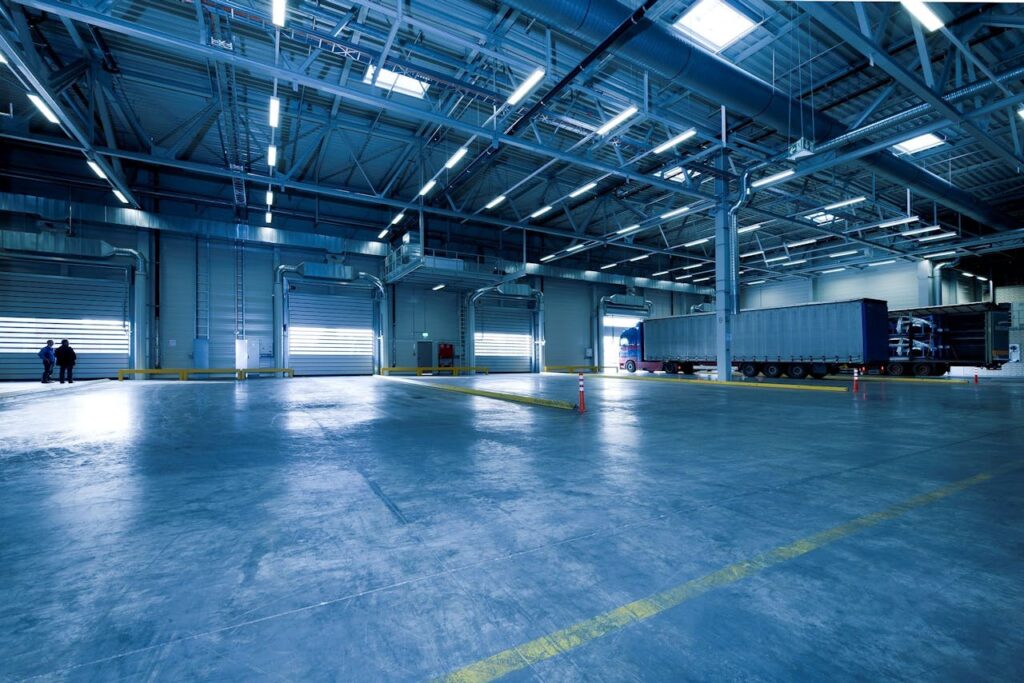
Loading docks represent the largest source of uncontrolled air infiltration in most distribution facilities. Every dock door cycle introduces exterior air directly into the conditioned space, and the cumulative effect on interior temperature stability is significant. Dock upgrades are a practical and high-impact component of building envelope work.
We coordinate the installation of high-speed doors, dock levelers, protective bumpers, and weather seals as part of the envelope scope. High-speed doors reduce the duration of each opening cycle, limiting the volume of exterior air that enters during loading and unloading. Dock levelers with integrated pit seals close the gap between the trailer floor and the dock opening, and perimeter weather seals address the remaining infiltration paths around the door frame and sides of the trailer.
Partition walls within the facility serve a related function. By separating temperature-sensitive zones from general receiving areas or staging spaces, we reduce the thermal load on controlled areas and give the HVAC system a smaller, more defined volume to maintain. These interior divisions also support operational organization, keeping product storage areas distinct from high-traffic zones where door activity is frequent.
Which HVAC And Ventilation Solutions Fit Large Warehouses And Distribution Centers?
Rooftop Units, Air Rotation, and Stratification Control
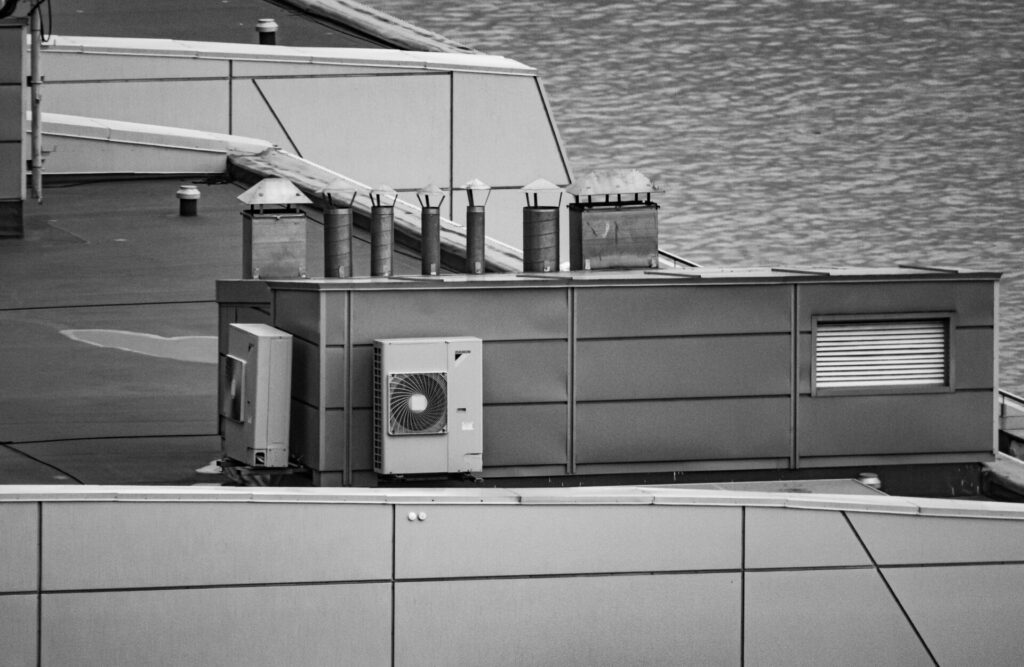
Rooftop units (RTUs) with programmable controls form the mechanical backbone of most large warehouse conversions. We position RTUs based on the racking layout and door-activity patterns identified during the assessment phase, ensuring conditioned air reaches occupied zones without fighting the facility’s natural airflow.
Air rotation units complement RTU installations by delivering long air throws across open floor plans without the cost and complexity of extensive ductwork. This approach keeps conditioning costs manageable while still achieving a uniform temperature distribution that product integrity and worker safety require.
Thermal stratification is one of the most persistent performance problems in high-ceilinged distribution spaces. HVLS fans address the issue directly by gently circulating air from ceiling to floor, breaking up the temperature gradient that naturally forms when warm air rises and cool air settles unevenly. We integrate HVLS fan placement with RTU positioning so both systems work as a coordinated network rather than competing.
Dock Area Conditioning and Cold Storage Refrigeration
Loading docks are among the highest-loss points in any climate-controlled facility. Dock-door heaters offset the cold-air intrusion that occurs during active shipping hours, while dock-door seals reduce infiltration when bays are closed. These measures help maintain the temperature consistency that the broader HVAC system works to deliver.
Zones designated for cold storage or temperature-sensitive inventory require dedicated refrigeration beyond what a standard RTU configuration can provide. We design these areas with separate refrigeration circuits that hold tighter tolerances, keeping sensitive products stable regardless of activity levels in adjacent general warehouse space.
Smart Controls and Energy-Efficient Operation
Smart thermostats and building automation enable real-time adjustments based on occupancy levels, door activity, and ambient conditions. Rather than running equipment at a fixed output throughout the day, energy-efficient controls modulate system performance to match actual demand, reducing unnecessary load during low-activity periods.
The practical impact of well-integrated controls is measurable. Facilities that have combined efficient RTU installation, enhanced ventilation systems, and smart controls have reported improved climate consistency alongside roughly 25% reductions in energy use. For distribution centers operating on thin margins, those efficiency gains translate directly to lower operating costs without sacrificing the stable interior conditions that protect both inventory and workforce performance.
What Does Installation, Commissioning, And Close-Out Look Like?
Once permits are approved, we move into mobilization. Equipment delivery, crane lifts for rooftop units, and ductwork runs typically occur within a focused installation window, usually weeks four through six of the project timeline.
Crews follow the approved design closely, but field conditions in large warehouse spaces can require real-time adjustments. We document any deviations from the contract drawings to keep the record set accurate and the project on track.
Ductwork routing in high-bay facilities demands careful coordination with existing racking infrastructure and overhead obstructions. Getting the sequencing right during mobilization and installation reduces the risk of costly rework later in the schedule.
Conclusion And Next Steps
A warehouse conversion succeeds or fails on two fronts: the integrity of the building envelope and the precision of large-space HVAC design. Gaps in either area can undermine product integrity, strain mechanical systems, and drive operating costs higher than necessary. Both pillars must work together for the facility to perform as intended.
Projects like this follow a clear sequence. A thorough site assessment and load analysis establish what the building actually requires, not what a rule of thumb suggests. Envelope upgrades, including insulated panels, vapor barriers, and loading dock controls, reduce the thermal burden before a single piece of mechanical equipment is selected. Equipment choices, whether RTUs, HVLS fans, air rotation units, or dedicated refrigeration, are then sized and positioned to address stratification, door activity, and workplace ventilation requirements. Permitting, installation, and commissioning follow in sequence, with performance verification at closeout confirming that the system delivers what the design promised.
At EB3 Construction, we manage every phase of this process, from the first site walk to final handover. Contact us to discuss your warehouse conversion and receive a scope tailored to your facility’s actual conditions.