
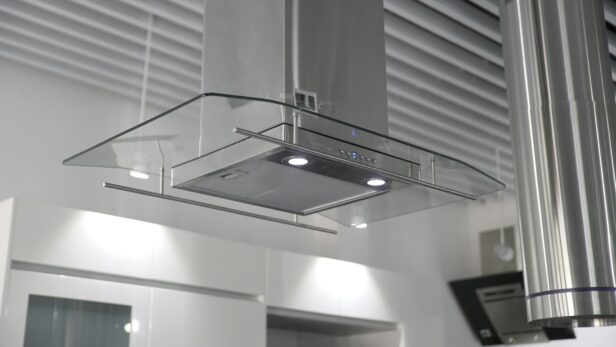
A commercial kitchen without a properly installed and maintained hood system carries a real fire risk. Grease vapors can accumulate, ducts go uncleaned, and suppression systems sit uninspected until a problem surfaces. Harris County’s fire code addresses each of these points through specific requirements for commercial kitchen hoods, operation and maintenance, inspection records, and gas appliance connections.
This article explains when a Type I hood is required, the listed alternatives and exceptions that apply, how ventilation and cleaning must be managed, and the servicing obligations for automatic fire-extinguishing systems and mobile gas appliances.
When Is A Type I Hood Required Over Commercial Cooking Equipment?

The trigger for a Type I hood requirement is straightforward: any commercial cooking appliance that produces grease vapors during operation must have a Type I hood installed over it. This applies equally to domestic cooking appliances used in a commercial setting. Once grease vapors are present, the requirement applies.
Under the International Mechanical Code (IMC), all commercial kitchen exhaust hoods must meet the code’s standards, and a Type I hood specifically addresses grease and smoke capture. The IMC defines commercial cooking appliances as equipment used in food service establishments for heating or cooking food that produces grease vapors, steam, fumes, smoke, or odors requiring removal through a local exhaust ventilation system. That definition is broad by design.
Which Equipment Requires a Type I Hood?
Medium-duty, heavy-duty, and extra-heavy-duty cooking appliances require a Type I hood without exception. Light-duty appliances also fall under the requirement when they produce grease or smoke during cooking. Equipment such as deep-fat fryers, griddles, charbroilers, ovens, rotisseries, and upright broilers all generate effluent that makes a Type I kitchen exhaust hood mandatory.
Domestic appliances used for commercial purposes carry the same obligation. A residential-grade range installed in a commercial food service establishment is not exempt because of its product classification. If the appliance is cooking food commercially and generating grease vapors, a Type I hood must be installed over it.
Why the Appliance Duty Classification Matters
The duty classification of a cooking appliance determines more than which hood type applies. It also drives the minimum exhaust airflow rate the hood must achieve. Extra-heavy-duty equipment, such as solid-fuel-burning appliances, demands more aggressive capture and containment than a light-duty convection oven. Getting the duty classification right during the design phase ensures the installed hood system meets IMC compliance thresholds, rather than simply looking the part during inspection.
Misidentifying appliance duty is a common source of code compliance problems in commercial kitchen construction. We review the equipment schedule carefully during coordination to confirm that each appliance is matched to the correct hood type and exhaust capacity before rough-in begins. A hood that is undersized for the appliance below it creates both a fire risk and a failed inspection.
What Listed Alternatives And Exceptions Can Apply To Hood Installations?
UL 710 Listed Factory-Built Exhaust Hoods
Factory-built commercial exhaust hoods listed and labeled in accordance with UL 710 and installed per IMC Section 304.1 carry a procedural benefit. They are not required to comply with several IMC subsections. The listing itself serves as the compliance pathway, replacing certain prescriptive IMC requirements.
This exception applies strictly to hoods that have completed the UL 710 evaluation process. The listing must be confirmed before installation, and the hood must be sized and configured in accordance with the manufacturer’s installation instructions and the conditions of the listing.
UL 710B Recirculating Systems
Factory-built commercial cooking recirculating systems listed and labeled under UL 710B and installed per IMC Section 304.1 receive the same IMC subsection exemptions as UL 710 hoods. These ductless systems filter and return air to the kitchen space rather than exhausting it outdoors. Because the air stays in the room, any space housing one of these systems is classified as a kitchen and must be ventilated according to IMC Table 403.3.1.1.
The ventilation calculation for these spaces uses a specific floor-area rule. Each appliance served by a recirculating system is considered to occupy at least 100 square feet of floor area for ventilation-rate purposes, regardless of its actual footprint. This figure drives the minimum fresh air supply required to keep the space code-compliant.
Integral Downdraft Exhaust Systems
A hood above a cooking appliance is not required when the appliance is equipped with an integral downdraft exhaust system. Both the appliance and its built-in exhaust system must be listed and labeled for that specific application in accordance with NFPA 96, the standard governing ventilation control and fire protection in commercial cooking operations. The listing for the application is the controlling factor; a generic listing does not satisfy this exception.
Downdraft systems capture cooking effluent at surface level and route it downward, typically through a grease duct connected beneath the appliance. Because the capture and containment function is built into the appliance, a separate overhead hood is unnecessary when the system meets NFPA 96’s listing criteria.
5 mg/m3 Grease Effluent Threshold for Electric Appliances
Electric cooking appliances can qualify for a Type I hood exemption based on measured grease output. An approved testing agency must document that the appliance’s effluent contains 5 mg/m3 or less of grease when tested at an exhaust flow rate of 500 cfm (0.236 m3/s) in accordance with UL 710B. The testing agency must be recognized by the authority having jurisdiction.
This threshold reflects the grease effluent limit established through UL 710B testing protocols, sometimes referenced alongside EPA Method 202 test procedures. The exemption applies only to electric appliances; gas-fired equipment does not qualify under this exception. If the appliance’s grease output exceeds the 5 mg/m3 threshold at the specified airflow, a Type I hood remains mandatory regardless of the appliance type or heat source.
How Should Ventilation, Cleaning, Inspections, And Records Be Managed?
Ventilation System Operation and Grease Filter Standards
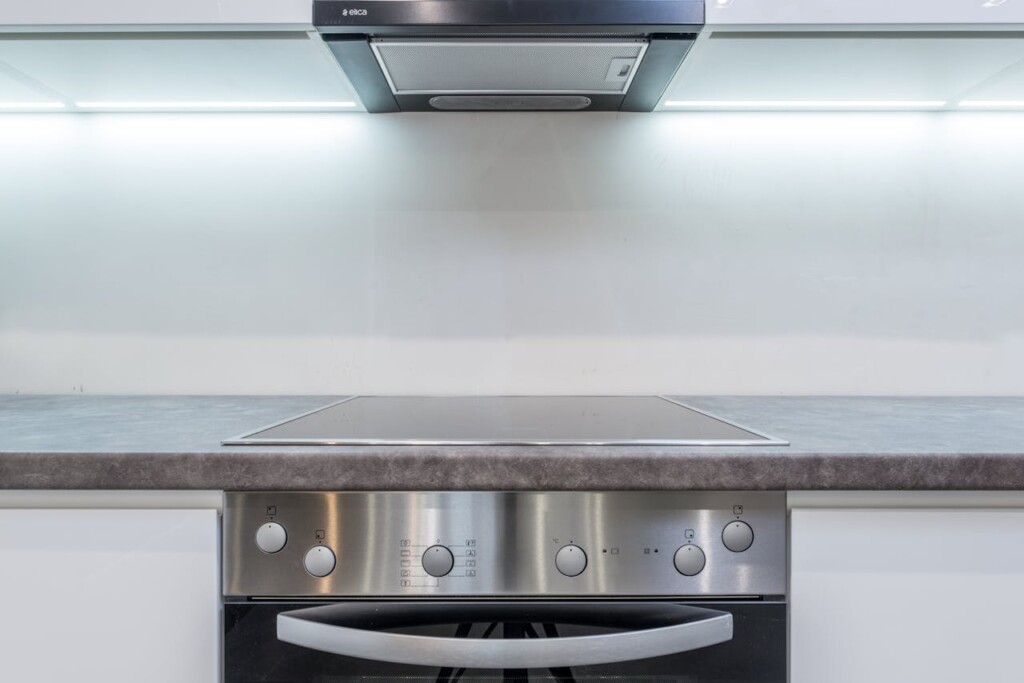
The ventilation system connected to a commercial kitchen hood must operate at the required airflow rate whenever cooking equipment beneath it is in use. Grease filters must be listed and labeled in accordance with UL 1046 and kept in place at all times during cooking operations. Removing or bypassing these filters, even briefly, puts the entire exhaust pathway at risk of direct grease exposure.
When grease extractors are installed as part of the hood assembly, they must operate continuously whenever the commercial cooking equipment runs. These grease-removal devices are not optional supplements; they are a core part of grease capture before contaminants reach the ductwork. Not running them defeats the protective function of the hood system.
Inspection Frequency by Cooking Operation Type
Inspections of hoods, grease-removal devices, fans, ducts, and other appurtenances must be completed by qualified individuals at intervals tied to the risk level of the cooking operation. The fire code sets distinct schedules based on how much grease a given operation generates and how frequently the equipment runs. A fire code official may also approve alternative intervals where justified by documented conditions.
The inspection schedule reflects the straightforward logic that higher-intensity cooking creates faster grease accumulation. Solid-fuel cooking operations, which include wood-burning and charcoal equipment, require inspection every month due to the dense combustible byproducts they generate. High-volume operations such as 24-hour cooking facilities, charbroiling operations, and wok cooking require inspection every three months.
Most commercial kitchens that fall outside those high-intensity categories are inspected every six months. Low-volume operations, including seasonal businesses, senior centers, and places of religious worship, operate under a twelve-month inspection cycle. These time-based thresholds exist because grease accumulation in fans and ducts can create fire conditions that may not be visible until a system failure occurs.
Cleaning Requirements and the ANSI/IKECA C10 Standard
When an inspection reveals grease accumulation in hoods, grease-removal devices, fans, ducts, or connected appurtenances, those components must be cleaned in accordance with ANSI/IKECA C10, the American National Standard for the methodology of cleaning commercial kitchen exhaust systems. This standard governs pre-cleaning inspection procedures, acceptable cleaning methods, and post-cleaning cleanliness benchmarks. It fills procedural gaps that broader fire codes leave unaddressed.
ANSI/IKECA C10 requires that cleaning be performed by properly trained, qualified, and certified personnel. The standard outlines what constitutes acceptable cleanliness after cleaning is complete, which means a visual pass is not sufficient. Components must meet defined cleanliness levels, not simply appear free of visible buildup.
Recordkeeping and Service Tag Requirements
Records for each inspection must document the individual and company that performed the work, a description of what the inspection covered, and the date it took place. Cleaning records follow the same structure: the performing individual, the company, and the date of service. Both sets of records must be completed after each event and maintained on an ongoing basis, as the fire code official may request them during an inspection.
Beyond written records, a physical service tag must be posted in a conspicuous location on the hood or duct system after each inspection. The tag must include the service provider’s name, address, telephone number, and date of service. Prior tags must be covered or removed so the current inspection date is clearly visible. This tagging requirement creates a readily accessible, on-site compliance marker that supports both internal accountability and regulatory review.
What Servicing Is Required For Fire-Extinguishing Systems And How Must Gas Appliances Be Connected?
Servicing Requirements For Automatic Fire-Extinguishing Systems
Under Section 904.12.6 of the International Fire Code, automatic fire-extinguishing systems protecting commercial cooking systems must be serviced at least every six months. Servicing is also required immediately after any activation of the system, regardless of when the last scheduled service occurred.
All inspections must be performed by qualified individuals. Upon completion, a certificate of inspection must be submitted to the fire code official. This documentation supplements the hood and duct recordkeeping described in the previous section and applies specifically to the suppression system itself.
Fusible links and automatic sprinkler heads within the system must be replaced at least annually. Other protective devices must be serviced or replaced according to the manufacturer’s instructions. One exception applies: frangible bulbs are not subject to the annual replacement requirement.
Compliance When Equipment Changes Occur
When existing commercial cooking systems undergo changes, the servicing obligations extend further. If the cooking media changes, cooking equipment is repositioned, or equipment is replaced, the automatic fire-extinguishing system must be brought into compliance with the applicable provisions for commercial cooking system protection.
Even a modification to the cooking line can trigger a full reassessment of whether the existing suppression system still adequately covers the updated equipment layout. We account for these factors during construction coordination and equipment layout reviews.
Gas Appliance Connection Requirements For Mobile Cooking Equipment
Gas-fired commercial cooking appliances installed on casters, and any appliances that are moved for cleaning or repositioning, have specific connection requirements. These appliances must use a gas appliance connector that complies with ANSI Z21.69, the standard governing connectors for movable gas appliances.
The connector alone does not meet the requirement. A proper restraining device must also be installed and fitted in accordance with both the connector manufacturer’s and the appliance manufacturer’s instructions. The restraint limits how far the appliance can be moved, which protects the gas connection from stress or accidental disconnection during repositioning or cleaning.
Mobile cooking equipment introduces risks that fixed installations do not. Repeated movement can cause wear on flexible gas connectors that fixed piping does not experience. Using a listed ANSI Z21.69 connector with a correctly installed restraining device addresses that risk by controlling range of motion and maintaining connection integrity.
Conclusion And Next Steps
Harris County’s commercial kitchen hood requirements follow a clear logic: match the hood type to the equipment, apply recognized exceptions only where the code and listed standards permit, and keep every system running and documented throughout the life of the operation. Type I hood requirements anchor the entire framework, with inspection and cleaning intervals, suppression system service schedules, and listed connector standards all building on that foundation. Gaps in any one of those areas create compliance exposure that can surface during a fire code official’s review or an insurance audit.
Maintenance records and service tags prove the system has been managed correctly over time. Scheduling inspections and cleanings with qualified professionals, keeping documentation current, and confirming code details during design and active operations are practical steps that keep a commercial kitchen code-compliant and operationally sound. The interval structure outlined in NFPA 96 gives operators a concrete framework to work from, and local requirements in Harris County should be confirmed directly with the authority having jurisdiction during the permitting and design process.
At EB3 Construction, we coordinate commercial kitchen buildouts with these code requirements integrated into the construction process from day one. Contact EB3 to discuss your commercial kitchen project and how we approach fire safety compliance during construction.