
A restaurant build-out within an occupied retail center carries risks that a standard tenant improvement project does not. Shared utilities, common walls, and active parking lots mean a poorly managed trade sequence can disrupt neighboring tenants, trigger landlord violations, and delay your opening by weeks.
The questions you ask when interviewing contractors for a restaurant project in a multi-tenant retail center determine whether you award the job to a team that can handle that complexity or one that learns on your dime. This article covers the key areas to probe: experience and references, licensing and insurance, contract protections, scheduling and communication controls, and restaurant-specific logistics.
What Experience, Portfolio, And References Should You Verify?

Years in the industry tell only part of the story. Start by asking directly: how long have you been building restaurants, and what share of your completed work is food service? A contractor who has spent years on office interiors or retail shell spaces carries a fundamentally different skill set from one who has coordinated MEP rough-ins around commercial hood placements or navigated health department walkthroughs for a food service occupancy.
The follow-up matters just as much. Press for specific experience in occupied, multi-tenant retail centers, where shared utilities, neighboring tenants, and landlord requirements add real layers of coordination complexity. General commercial experience is not a substitute for that environment.
Review the Portfolio in Detail
Request a portfolio and look past the finished photography. Ask to see projects that match your shell space conditions and the type of center you are building in. A strong portfolio reflects documented problem-solving, not just attractive interiors.
As you review the work, ask for concrete examples of restaurant-specific challenges the contractor resolved. Did they manage a grease management system installation when the existing drain configuration was inadequate? How did they handle ventilation routing in a space with limited ceiling clearance or structural constraints? Did the build achieve ADA compliance on the first inspection pass? These details separate contractors with genuine restaurant construction experience from those with general commercial backgrounds.
Also confirm the portfolio includes your concept type. A contractor whose work skews toward fast-casual counter-service layouts may not have the spatial logic or finish coordination experience that a full-service dining room or bar-forward concept demands. Flag that gap before moving further in the process.
Contact References and Ask the Right Questions
A qualified contractor will provide client references without hesitation. Call at least three, and confirm they come from recent restaurant or commercial kitchen projects rather than older work that predates current code requirements. Older references carry less weight when health codes, fire suppression standards, and ADA requirements continue to evolve.
When you connect with those references, focus on performance specifics. Did the contractor finish on schedule and within budget? How did they handle unexpected site conditions mid-build? Would the client hire them again? Those three questions reveal what credentials alone cannot.
Pay attention to how references describe the contractor’s ability to manage multiple stakeholders. Restaurant projects in retail centers routinely involve coordination among the property owner, tenant, architect, equipment vendors, and multiple trade subcontractors. A contractor who communicates clearly across those relationships keeps the project moving. If the references indicate the owner had to manage those relationships personally, that is a signal worth taking seriously.
What Licenses, Insurance, And Contract Terms Should You Confirm Upfront?
Contractor Licensing: Verify Scope and Authority
A general contractor’s (GC’s) license must cover the full scope of a restaurant build-out, including the structural, mechanical, electrical, and plumbing trades specific to food service environments. Ask for the license number directly and verify it through your state’s contractor licensing authority before moving forward.
Licensing requirements vary by jurisdiction, and some states require separate licenses for specific trades such as plumbing and electrical work. If the contractor plans to self-perform those scopes, confirm each license independently. If work will be subcontracted, confirm those subs carry their own licenses and ask how the GC monitors compliance.
Insurance Requirements: CGL, Workers’ Compensation, and Bonding
Request current certificates of insurance before moving to contract review. For commercial general liability (CGL) coverage, many jurisdictions set minimum thresholds at $1 million per occurrence and $2 million aggregate for commercial projects, though restaurant build-outs in occupied retail centers may warrant higher limits given the adjacent tenant exposure.
Workers’ compensation coverage is non-negotiable. A lapse in that coverage shifts liability for on-site injuries directly to the property owner or developer. Confirm that the policy is active and that it extends to all employees and subcontractors working on your project, not just the GC’s direct payroll.
A surety bond provides a financial backstop if the contractor fails to complete the work or defaults on subcontractor payments. Ask about bonding capacity and the strength of the surety company backing the bond. A contractor bonded through a financially weak surety may offer limited protection when you need to make a claim.
Example: The figures below are Pennsylvania-specific and oriented to home improvement work. Verify requirements and limits for your jurisdiction and commercial project type.
| Insurance Type | Requirement | Coverage Amount |
| General Liability Insurance | Required for most contracting work and HIC registration | $50,000 – $1,000,000 |
| Workers Compensation | Mandatory for contractors with employees in Pennsylvania | Varies by classification |
| Home Improvement Bond | Required for registered home improvement contractors | $20,000 |
| Commercial Auto | Conditional, required if using vehicles for business purposes | $750,000+ |
Contract Protections: Payment Terms, Retainage, and Lien Prevention
The contract structure should reflect milestone-based or progress payments tied to verified completed work, not arbitrary dates. Retainage, typically held at 5 to 10 percent of each progress payment, provides financial leverage to ensure punch list items and final inspections are completed properly before full payment is released.
Subcontractor liens are a real risk on restaurant projects where multiple trades are working simultaneously. Ask how the contractor handles lien waivers at each payment cycle. Conditional lien waivers should be exchanged at payment, and unconditional waivers should follow once funds clear, protecting your property from third-party claims against unpaid subs.
A termination clause is a practical safeguard, not a formality. Confirm that the contract includes clear termination conditions, notice periods, and a defined settlement process for work completed to date. Align on a maximum materials budget within the contract so procurement decisions don’t outrun the agreed scope without your approval.
Materials Sourcing, Warranties, and Change Orders
Materials sourcing affects both cost and schedule and deserves direct scrutiny. Ask where the contractor sources key materials, whether they have preferred supplier relationships, and how supply chain disruptions or lead time delays are communicated and managed. Restaurant projects often have long-lead items such as custom millwork, commercial kitchen equipment rough-ins, and specialty tile that require early procurement decisions.
Workmanship warranties should be spelled out in writing. Understand what is covered, for how long, and what process the contractor follows when a warranty issue is reported after substantial completion. Vague warranty language creates disputes; clear terms protect both parties.
The change-order process deserves equal attention. Ask how the contractor documents scope changes, what triggers a formal change order versus a field adjustment, and how pricing is calculated when costs shift. A disciplined change-order process keeps the budget transparent and prevents small issues from compounding into end-of-project disputes.
How Will The Contractor Manage Schedule, Communication, And On-Site Coordination In An Occupied Center?
On-Site Leadership And Decision Authority
First, identify who runs the job day to day. A dedicated superintendent or full-time, on-site project manager means decisions get made in real time, without waiting for a call back from another project. If the PM splits time across multiple projects, ask who holds decision authority at the field level and whether the foreman can approve or stop work without escalation.
Foreman authority matters most in fast-moving situations when a trade conflict or unexpected condition requires an immediate decision. A foreman who must wait for off-site approval stalls the job. Confirm that the foreman on your project has clear, documented authority to coordinate trades, redirect sequencing, and flag issues before they cascade into schedule delays.
Research from the Construction Industry Institute consistently shows that nearly 88% of delayed projects also run over budget, which means the person in charge on the ground is not an administrative detail; it is a financial safeguard.
Communication Cadence And Single Point Of Contact
Before work begins, lock in how and when updates will be delivered. Daily check-ins work well for fast-moving phases with multiple active trades. Weekly structured updates suit steadier production stretches. Either way, agree on the channel—whether a project management platform, email summary, or scheduled call—and stick to it.
Designate a single point of contact on both sides. When questions, decisions, or concerns route through multiple people, response times slow and records fragment. A named contact on the contractor’s side and a named contact on the owner’s side remove ambiguity and keep communication logs clean and traceable.
Meeting minutes and action items should be distributed within 24 hours of any coordination meeting. Items that remain unresolved between meetings become delays that push your opening date and compound into budget overruns.
Look-Ahead Scheduling And Trade Sequencing
Ask the contractor how they structure their look-ahead schedule. A rolling three-week look-ahead schedule shows which trades are active each week, what handoffs are coming, and where conflicts may develop before they hit the job site. This is a practical mechanism for preventing one crew from sitting idle because another trade has not finished.
In an occupied retail center, site hours matter as much as trade sequencing. Confirm that the construction schedule accounts for neighboring tenant operations, shared access points, and delivery windows that avoid disrupting parking or pedestrian flow. Work that creates excessive noise or blocks access during peak retail hours can trigger landlord action or lease violations.
Posting a daily schedule for each active trade—not just filing a master Gantt chart in a drawer—keeps field teams aligned and reduces the chance of sequencing conflicts that compress the critical path and push the substantial completion date.
Cleanup Plan And Waste Removal
A daily cleanup plan signals professional site discipline, and in a multi-tenant retail center, it carries operational weight beyond tidiness. Debris in shared corridors, dust drifting into adjacent tenant spaces, and dumpsters blocking service lanes all create friction with the property manager and neighboring businesses.
Ask how waste is staged, how frequently it is removed, and who is responsible for end-of-day cleanup for each trade. A contractor who assigns cleanup duties to a designated laborer rather than leaving it to each subcontractor produces a consistently cleaner site. Confirm that the waste removal plan aligns with the center’s rules on dumpster placement, haul routes, and disposal schedules.
Weather Contingency And Schedule Recovery
Weather disruptions affect every exterior phase of a restaurant build, from rooftop penetrations for exhaust systems to parking lot work and utility connections. Ask the contractor how they account for weather days in the baseline schedule and what their recovery protocol is when days are lost.
A credible answer includes buffer days built into the schedule logic, not just an optimistic completion date with no float. Recovery options typically include adjusted crew sizes, extended shifts, or revised trade sequencing to compress noncritical path tasks. Contractors who have a documented weather contingency plan have thought through the problem before it occurs, rather than reacting after the schedule has already slipped.
Safety Discipline And EMR
Request the contractor’s Experience Modification Rate, commonly called the EMR, before any award decision. The EMR measures a contractor’s safety performance relative to industry averages. A rate below 1.0 indicates a better-than-average safety record. A rate above 1.0 signals more frequent or more costly incidents than the industry norm, carrying insurance and liability implications for the project owner.
Beyond the number, ask to see the site-specific safety plan for your project. A generic safety document carried from job to job is not the same as a plan that addresses the actual conditions of building inside an occupied retail center, including pedestrian barriers, dust containment, and coordination with neighboring tenants. Weekly toolbox talks and a documented protocol for reporting and managing injuries round out the safety picture.
According to the National Safety Council, projects that conduct weekly toolbox talks addressing site-specific hazards reduce OSHA recordable incident rates significantly. A contractor who builds safety discipline into the weekly schedule rather than treating it as paperwork demonstrates the operational maturity that a complex, occupied center build demands.
What Restaurant-Specific Logistics Should You Cover Before Awarding The Job?
Permits and Inspections
Restaurant construction touches at least three permitting tracks simultaneously: building, health department, and fire authority. Ask the contractor directly who owns each submission, who tracks resubmittals, and who manages responses when a reviewer sends corrections.
A single point of ownership on the permit tracker prevents submissions from stalling between trades or getting lost in handoffs. Before awarding the job, confirm the contractor has a documented plan to align all final sign-offs so occupancy certification does not hinge on one outstanding inspection from another agency.
Health department coordination deserves particular attention. Reviewers frequently flag kitchen layouts, grease interceptor sizing, and handwashing station placement during plan check. A contractor who has navigated these reviews before will anticipate those comments early rather than scrambling to revise drawings after permits are already in process.
Kitchen Hood, Exhaust, and Fire Suppression
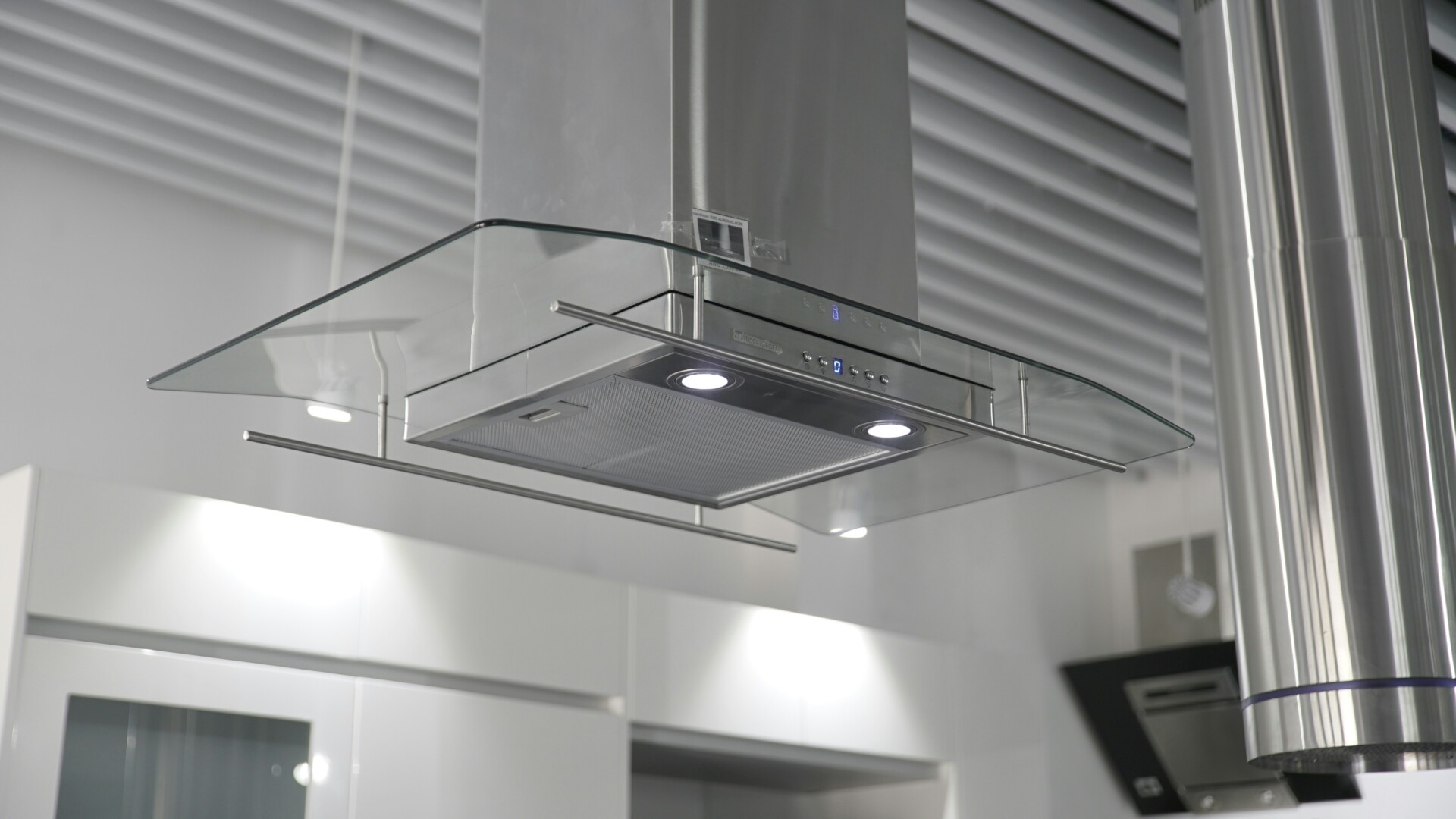
The exhaust hood system shapes nearly every other kitchen decision. Confirm the contractor understands the difference between a Type I hood, required over all grease-producing cooking equipment under NFPA 96, and a Type II hood used for heat and steam only. Installing the wrong type is a fire code violation that will fail inspection and require costly rework.
Duct routing and roof penetrations need to be resolved on paper before a single piece of ductwork is fabricated. Ask how the contractor plans to route the grease duct to a direct exterior termination without conflicting with structural members, adjacent tenant spaces, or existing roof equipment. This routing decision affects framing, roof membrane work, and the rooftop exhaust fan location.
Make-up air is the part of hood systems most often underestimated. For every cubic foot of air the exhaust system removes, an equivalent volume must return through the make-up air unit. An undersized MUA system creates negative pressure in the kitchen, which causes doors to pull shut, gas appliances to backdraft, and staff comfort to deteriorate. Verify that the contractor is sizing make-up air in coordination with the hood, not treating it as an afterthought. Fire suppression nozzles must also be positioned directly above each piece of protected cooking equipment and integrated with both the hood and the gas-shutoff interlock before any rough-in work begins.
Walk-In Cooler Coordination
Walk-in coolers and freezers generate structural and MEP demands that catch unprepared contractors off guard. Before awarding the job, confirm the contractor has reviewed the combined dead and live loads of each walk-in unit against the floor slab’s capacity. Oversized coolers on reinforced slabs are straightforward; walk-ins on elevated decks or wood-framed floors require a structural engineer’s sign-off.
Refrigeration lines, floor drains, and condensate routing all need to be mapped against the kitchen layout before rough-in begins. Ask specifically how the contractor plans to route refrigeration lines to the remote condensing unit, where the floor drain sits relative to the cooler threshold, and how the electrical circuit for the compressor is isolated from other high-demand kitchen circuits. These coordination details surface late when no one asks about them early.
MEP Coordination for Restaurant Equipment
Gas sizing is one of the most common MEP failure points in restaurant construction. The contractor should size the gas supply line for simultaneous operation of every gas-fired appliance, not just the largest single unit. Undersizing the line forces the owner to upsize infrastructure after the kitchen is already built, which typically means cutting floors or opening walls.
Floor drains and mop sinks need to be positioned based on the final equipment layout, not roughed in from a generic plan. Ask the contractor how they sequence equipment submittals with MEP rough-in so drain locations reflect where appliances will actually sit. Hot water recovery should account for the simultaneous demand of the dishwasher, three-compartment sink, and any steam equipment. Commercial kitchens can require 200 to 400 amps or more of electrical service depending on equipment load, so confirm that dedicated circuits are planned for high-draw appliances such as combi ovens, fryers, and walk-in compressors before the electrical panel is sized.
Front-of-House Finishes, Lighting, and Acoustics
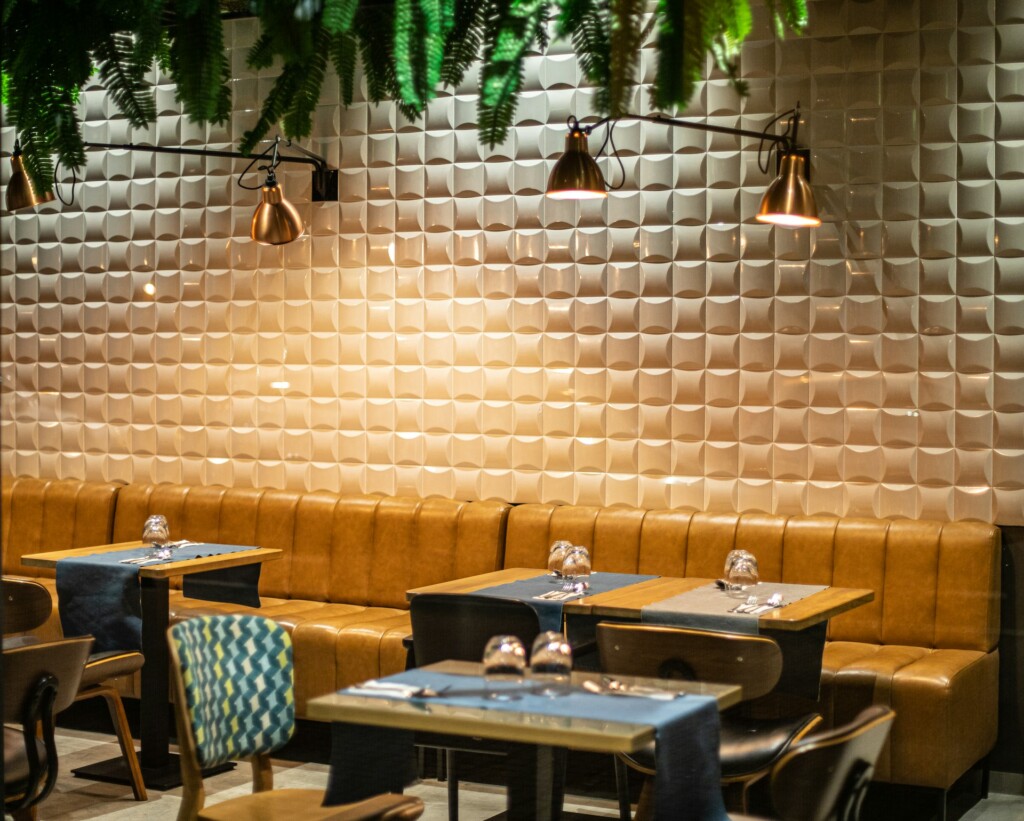
Guest flow, code-compliant finish selections, lighting control zones, and acoustic treatments belong in the pre-award conversation, not in a value-engineering discussion after the project is half-built. Ask the contractor how they handle coordination between the finish schedule and any landlord-required base building standards, and whether their subcontractors are familiar with the local authority’s finishes review process.
Lighting control zones for dining, bar, and service areas each carry different electrical and programming requirements. A contractor who waits until drywall is up to ask about dimming systems will create conduit conflicts and change orders. Acoustic treatments—specifically ceiling absorption panels, wall treatments, and any floating baffles—require blocking and backing installed during framing. Asking about acoustic scope after framing is complete means either opening walls or accepting a lesser solution.
Phased Construction and Active Center Operations
An occupied multi-tenant retail center requires a phasing plan that accounts for neighboring tenants, shared parking, delivery routes, and pedestrian traffic. Ask the contractor how they intend to sequence work to contain dust, limit noise during peak retail hours, and maintain a clear, code-compliant pedestrian path along the storefront at all times.
Dust control inside the shell is straightforward with temporary barriers and negative air machines, but dust migrating through shared HVAC returns or under demising walls can trigger complaints from adjacent tenants within hours. Confirm the contractor’s plan for sealing those pathways before any demolition or drywall cutting begins. After-hours work is sometimes the only way to run noisy trades without disrupting neighbors, so establish whether the contractor has the crew availability and supervisory coverage to support that schedule before you award the contract.
Design Coordination and Value Engineering
Continuous coordination between the contractor and the architect is not optional on a restaurant build-out. Drawing sets evolve through permit corrections, equipment substitutions, and landlord comments, and the field team needs to be working from current documents at every phase. Ask the contractor how they manage drawing revision control and how quickly updated drawings reach the subcontractors on site.
Value engineering should happen before award, not after. When a contractor proposes a substitution that reduces cost, the architect needs to confirm that the substitution preserves the functional and code intent of the original design. Changes to duct material, hood configuration, finish category, or equipment grade can have downstream effects on inspections, warranties, and occupant experience. A contractor who brings value engineering proposals to the design team early, with enough time to evaluate and decide, is operating the way the process should work.
Conclusion And Next Steps

Before you award the contract, run through these concrete next steps. Prepare your portfolio review checklist and confirm the contractor’s past work matches your shell conditions and concept type. Request all credentials and certificates of insurance, verify license numbers with the issuing authority, and confirm bonding capacity. Agree on a communication cadence and identify a single point of contact for the duration of the project. Finally, map your inspection sequence and MEP scope to your equipment delivery schedule so rough-in and sign-off timelines align from day one. Closing those gaps early keeps your opening date intact and protects nearby tenants.
At EB3 Construction, we work through this due diligence process alongside developers and property owners on every restaurant build-out we coordinate. Contact us to discuss your multi-tenant retail center project.